
Best Ping Pong Paddles: Premade vs Custom, Speed and Spin
Which ping pong paddle to buy: premade or a custom blade with two rubbers, what speed and spin ratings mean, sponge, handles, ITTF rules and 2026 prices.
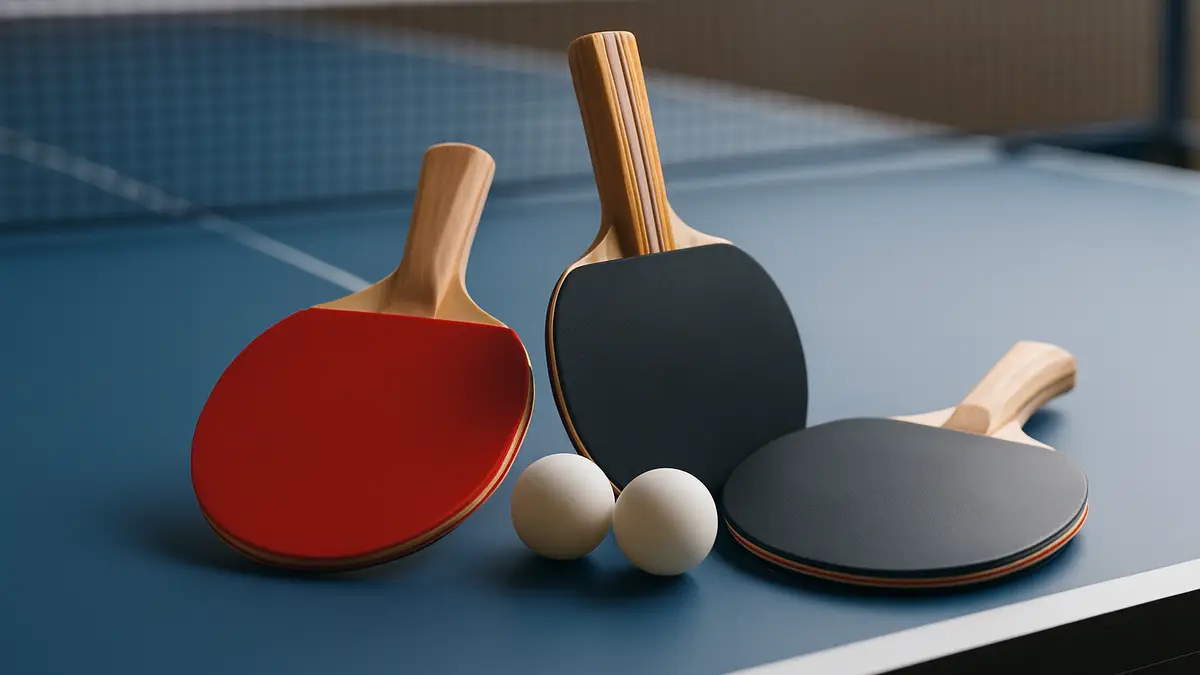
A ping pong paddle costs from $8 to over $400, and almost all of that range is about the rubber. The useful decisions are simple: premade or custom, how fast a paddle you can control, and which handle fits your grip. This guide covers each, explains why the speed and spin numbers on the box do not compare across brands, and names paddles at prices we checked on October 6, 2026.
Which ping pong paddle should you buy?
Buy a premade paddle with ITTF-approved rubber unless you train every week. A premade paddle comes assembled and ready to play; a custom paddle is a blade and two rubbers you choose and glue on yourself or have a shop assemble.
| If you are | Buy | Example (US price, Oct 2026) |
|---|---|---|
| A family or occasional player | All-wood premade, ITTF rubber | Butterfly 401 FL, $37.99 |
| A regular home player who wants more spin | Premade with carbon layers | JOOLA Infinity Overdrive, $69.95 |
| A fast attacker on a budget | Carbon premade | STIGA Carbon+, $99.99 |
| An intermediate player | Premade with replaceable-grade rubber | Butterfly 802 FL, $144.99 |
| A club player | Custom blade plus two rubbers | Butterfly Korbel blade and two Glayzer rubbers, about $179 |
| A player who wants a pro setup assembled | Factory-assembled pro paddle | Butterfly Timo Boll ALC Pro-Line with Tenergy 05, $344.97 |
Prices are from the maker’s own US store and change with sales.
Premade or custom: what is the difference?
A premade paddle is sold assembled, with rubber glued to the blade at the factory. A custom paddle is built from three parts: a blade and two sheets of rubber with sponge, one for each side. Custom costs more but lets you replace one worn rubber instead of the whole paddle.
| Premade | Custom | |
|---|---|---|
| Price | $25 to $145 for most; pro assembled models more | About $180 for a mid setup; $450 and up for premium parts |
| Rubber | Often a house brand; glued for good | Your choice of rubber on each side |
| When rubber wears | Usually replace the paddle | Replace only the rubber, $55 to $120 a sheet at Butterfly |
| Who it suits | Families, beginners, casual players | Weekly and league players |
Butterfly notes that the rubber on its 802 FL is permanently glued and cannot easily be replaced, unlike its Pro-Line paddles. That is typical for premade paddles at this price.
Do speed and spin ratings mean anything?
Within one brand, yes. Across brands, no. Every maker rates its own paddles on its own scale, and the numbers are marketing as much as measurement.
| Paddle or rubber | Maker’s rating | Price (Oct 2026) |
|---|---|---|
| JOOLA Infinity Overdrive (premade, Micron 48 rubber) | Speed 100, spin 99, control 92 (JOOLA) | $69.95 |
| STIGA Carbon+ (premade, S5 rubber) | Speed 98, spin 94, control 75 (STIGA) | $99.99 |
| Butterfly Tenergy 05 rubber (on the Timo Boll ALC Pro-Line) | Speed 83, spin 76 (Butterfly) | $344.97 for the paddle |
Read literally, the $70 JOOLA paddle beats a pro-level rubber on a $345 paddle. It does not; Butterfly simply uses a different scale. Use ratings to pick between two paddles from the same brand, and use the price, rubber name and blade construction to compare across brands.
Which premade paddles are worth buying?
These paddles cover the useful range. All use rubber the maker describes as ITTF-approved or come from the maker’s competition line.
| Paddle | Blade | Rubber and sponge | Price (Oct 2026) |
|---|---|---|---|
| JOOLA Carbon Control | Not listed | Not listed | $24.95 |
| Butterfly 401 FL | 5-ply wood | Yuki, 2.1 mm sponge, ITTF-approved | $37.99 |
| JOOLA Infinity Overdrive | 5-ply wood plus 2 carbon layers, 6.1 mm | Micron 48 inverted | $69.95 |
| STIGA Carbon+ | 7-ply: 5 balsa plus 2 carbon | S5 inverted, 2 mm sponge, ITTF-approved | $99.99 |
| JOOLA White Infinity Carbon | 5-ply plus 2 layers of 3K carbon | Micron+, ITTF-approved | $129.95 |
| Butterfly 802 FL | 5-ply wood plus 2 arylate-carbon (ALC) | Wakaba and Flextra, 2.1 mm sponge, ITTF-approved | $144.99 |
| Butterfly Timo Boll ALC FL Pro-Line | 5-ply wood plus 2 ALC | Tenergy 05 both sides, 2.1 mm sponge | $344.97 |
Pick by control, not power. An all-wood blade like the 401 FL is slower and easier to keep on the table. Carbon layers add speed, which helps a player who already controls the ball and hurts one who does not.
What does a custom paddle cost?
About $180 for a solid club setup, and $450 or more with premium parts. These are Butterfly’s US store prices on October 6, 2026:
| Setup | Blade | Rubbers (two sheets) | Total |
|---|---|---|---|
| Club all-round | Petr Korbel, $68.99 | Glayzer, $54.99 each | $178.97 |
| Club with pro rubber | Primorac, $76.99 | Tenergy 05, $79.99 each | $236.97 |
| Premium | Viscaria Super ALC, $269.99 | Dignics 09C, $93.99 each | $457.97 |
You also need rubber glue, and many shops assemble a custom paddle for you. The premium setup only makes sense for a player who can use the extra spin; for most home players it is faster than they can control.
What sponge thickness should you choose?
Around 2 mm for most players. The sponge sits under the rubber and adds speed and spin as it gets thicker; thinner sponge gives more control and a slower ball. Every paddle above that lists its sponge uses 2.0 or 2.1 mm, a middle thickness that suits most players.
Beginners and defensive players do better with thinner sponge. Attackers who loop from mid-distance usually go thicker.
Which handle shape fits you?
Flared is the most common and the safest first choice: the handle widens at the end so it does not slip out of your hand. Butterfly calls it the most popular style.
- Flared (FL): wider at the bottom, secure grip. Most premade paddles.
- Straight (ST): the same width end to end, easy to change grip for backhand play; often chosen by defensive players.
- Anatomic (AN): a bulge in the middle that fills the palm.
- Penhold: a short handle held like a pen, common in Asian playing styles.
Butterfly sells the same Timo Boll ALC Pro-Line in flared, straight and anatomic versions at $344.97, so handle shape costs nothing extra.
What makes a paddle legal for club play?
The ITTF racket rules decide what is legal in sanctioned play. The main points:
- Blade: at least 85% natural wood by thickness. Carbon or other fiber layers may not exceed 7.5% of the total thickness or 0.35 mm.
- Rubber: must be an ITTF-authorized type. Look for “ITTF approved” on the listing.
- Colors: one side black. Since October 2021 the other side may be red, blue, green, pink or violet; before that it had to be red.
None of this matters for basement games, but it does if you join a club or league. A paddle with unapproved rubber or one color on both sides is not legal there.
What else do you need with a paddle?
Balls and a case. The official ball is 40 mm and 2.7 g, made of plastic since 2015. A 24-pack of STIGA 3-star balls cost $24.99 in October 2026; 1-star balls are cheaper and fine for practice. Outdoor play has its own balls ($8.99 for a STIGA outdoor pack); our outdoor ping pong tables guide covers outdoor play.
Keep paddles in a case and out of the sun. Heat and dust dry out rubber, and a dusty surface loses grip. Rubber cleaner and a sponge restore some tack between games.
Is a 4-paddle set a good buy?
For families and parties, yes. Sets like the STIGA Performance 4-Player Set ($39.99) or Butterfly’s RDJ 4-Player Set ($62.99) put four people at the table for the price of one good paddle. Set paddles are basic, which is fine for children and new players. Buy one better paddle later for whoever starts to play seriously.
Who does not need an expensive paddle?
- Families playing on a conversion top. The surface sits higher than a real table and bounces less evenly; see our ping pong conversion tops guide.
- Players on a toy-grade combo table. A small multi-game top limits play more than the paddle does; our multi-game tables guide explains.
- Anyone with a thin-top table. A 12 mm top gives an uneven bounce that no paddle fixes. Our best ping pong tables guide and table dimensions guide cover what makes a good table.
Where do these numbers come from?
We did not test these paddles. Specs, ratings and prices come from the maker’s US store, checked on October 6, 2026:
- Butterfly paddles, blades and rubbers: Butterfly recreational and Pro-Line racket pages, blades and rubbers.
- JOOLA paddles: JOOLA table tennis rackets.
- STIGA paddles, sets and balls: Escalade Sports, which sells STIGA table tennis products in the US.
- Racket rules and ball specs: the ITTF equipment rules as summarized on Wikipedia’s Table tennis and Table tennis racket entries.
Frequently asked questions
Quick answers to what readers ask us most
What is the best ping pong paddle for a beginner?
A premade paddle with a 5-ply all-wood blade, ITTF-approved rubber and a flared handle. The Butterfly 401 FL ($37.99, October 2026) fits that description exactly. Avoid very fast carbon paddles at first; they make it harder to keep the ball on the table.
Are expensive ping pong paddles worth it?
Only for players who train and use spin on purpose. A $345 paddle with Tenergy rubber gives a skilled player more spin and speed; a casual player will mostly notice that the ball flies long. Spend on better rubber before a fancier blade.
What do speed and spin ratings on a paddle mean?
They are each maker's own scores, not a shared standard. JOOLA rates its $69.95 Infinity Overdrive at speed 100 and spin 99, while Butterfly rates Tenergy 05, a pro-level rubber, at speed 83 and spin 76. Compare ratings only within one brand.
What are the rules for a legal table tennis paddle?
Under ITTF rules the blade must be at least 85% natural wood by thickness, with fiber layers limited to 7.5% of the thickness or 0.35 mm. The rubber must be ITTF-approved, one side black and the other red, blue, green, pink or violet since October 2021.
How often should you replace ping pong paddle rubber?
When it stops gripping the ball. Rubber loses tack with use, sun and dust, and a worn surface makes spin serves and loops harder. On a premade paddle with glued-on rubber, that usually means a new paddle; on a custom paddle you replace only the rubber.