
Best Pool Cues: Shafts, Weight, Joints, and Real Prices
Which pool cue to buy: maple, low-deflection or carbon shaft, 18 to 21 oz, 12 to 13 mm tips, joints and short cues, with named cues and October 2026 prices.
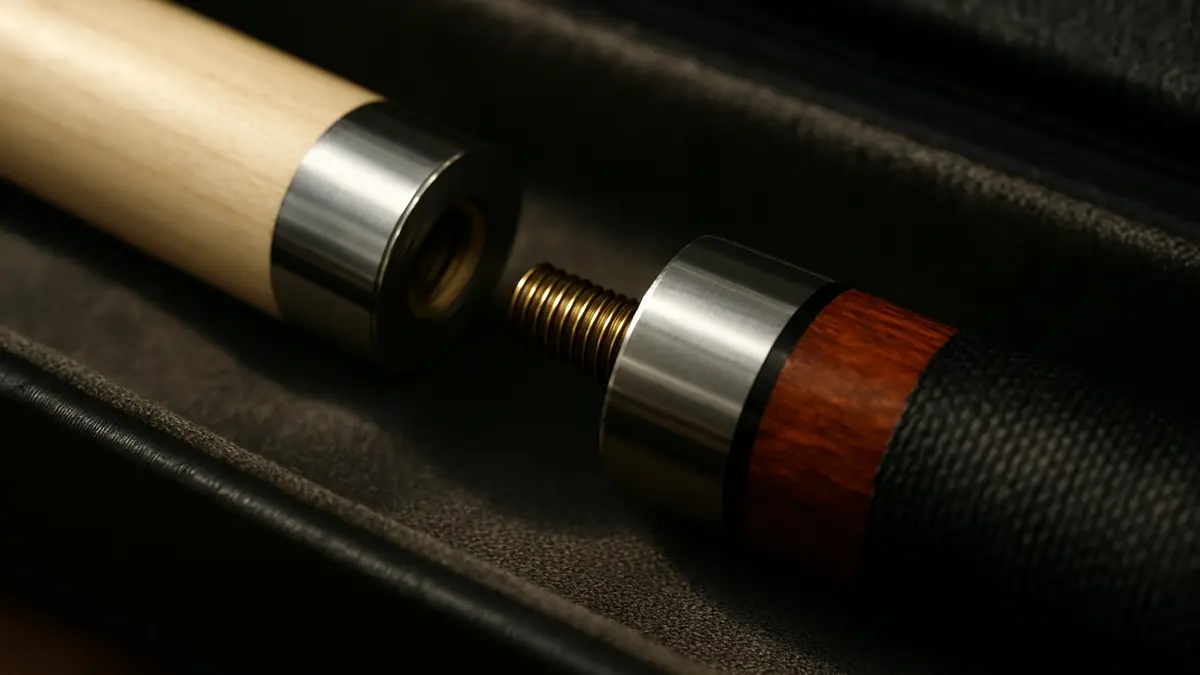
A cue is the one piece of pool equipment every player touches on every shot, and the cue that came with your table is usually its weakest part. The choice is simpler than the catalogs make it look. Most of the difference between a $110 cue and a $1,100 cue sits in the shaft, so this guide sorts cues by shaft first, then covers weight, tip size, joints, wraps and length, and ends with named cues at prices we checked on October 6, 2026.
Which pool cue should you buy?
Most home players should buy a two-piece maple cue with a 13 mm tip for $110 to $180, and upgrade the shaft later only if they start playing every week. The table maps common situations to a cue type and a current example.
| If you want | Buy | Example (US price, Oct 2026) |
|---|---|---|
| A first cue of your own | Two-piece maple, 13 mm tip, 19 oz | Viking Valhalla VA110, $112 (Seybert’s) |
| A maple cue with nicer finish and a wrap | Two-piece maple, linen wrap | McDermott Lucky L10, $165 (Seybert’s) |
| Less cue ball deflection without carbon | Low-deflection maple shaft | Cuetec AVID Chroma, $289 (Seybert’s) |
| A complete carbon fiber cue | Carbon shaft on a maple butt | Poison Maelith, $449 (Predator) |
| A carbon shaft for a butt you already own | Carbon shaft in your joint | Cuetec Cynergy, $449 sale, $499 list (Seybert’s) |
| A short cue for a cramped wall | 48 or 52 in cue | Players PL52, $38.70 sale (Ozone Billiards) |
Prices change often and many listings sell out, so treat these as a guide to the price band rather than a quote.
What does the shaft change?
The shaft decides how far the cue ball pushes off line when you hit it left or right of center. That push, called deflection or squirt, is why a shot with side spin can miss even when your aim was right. Shafts with less mass near the tip deflect the cue ball less.
| Shaft type | How it is built | What it feels like | Shaft-only price (Oct 2026) |
|---|---|---|---|
| Standard maple | Solid hard rock maple, usually a 13 mm tip | Traditional hit, most deflection | Usually comes with a $100 to $250 cue |
| Low-deflection maple | Spliced or hollowed maple, lighter front end | Wood feel, less squirt | Mezz WX700 $280 to $320; Predator 314-3 from $359 |
| Low-deflection with carbon core | Maple with a carbon fiber core in the front 7 in | Close to maple, steadier hit | Comes on the McDermott G-Series ($445 MSRP for the G201) |
| Carbon fiber | Carbon composite tube, no ferrule on most | Firm, very consistent, lowest deflection | Cuetec Cynergy $449 sale; Predator REVO $549 |
Predator says its 314 shaft has been sold since 1994, and the 314-3 is the current spliced-maple version with a 12.75 mm tip. Carbon shafts add two practical benefits on top of low deflection: they do not warp, and they react less to humidity. Predator and Cuetec both give a lifetime warranty against warpage on these shafts.
Who does not need a low-deflection shaft: players who mostly hit center ball. If you rarely use side spin, a standard maple shaft costs a fraction of the price and plays the same for you.
How heavy should a pool cue be?
19 oz is the usual starting weight, and almost every play cue is sold between 18 and 21 oz. McDermott, for example, offers weights from 18 to 21 oz in half-ounce steps on most models, and Cuetec’s AVID cues use a weight bolt system so you can change it later.
- 18 to 19 oz: more feel on soft position shots; a common choice for players with a smooth stroke.
- 20 to 21 oz: more mass behind the ball, so breaks and power shots need less arm speed.
- Over 21 oz: rare in play cues. The WPA allows up to 25 oz in competition.
Weight is easy to overthink. A half-ounce change matters far less than the shaft and the tip, so pick 19 oz unless a heavier or lighter cue already feels better in your hand.
What tip size should a cue have?
Standard maple shafts end at about 13 mm. Low-deflection and carbon shafts are often slimmer: Predator’s REVO comes in 11.8, 12.4 and 12.9 mm, and Cuetec’s Cynergy in 10.5, 11.8 and 12.5 mm. The WPA allows tips up to 14 mm.
A smaller tip gives a more precise contact point for spin; a larger tip is more forgiving and feels familiar to bar players. McDermott builds shafts from 11.75 to 14 mm in quarter-millimeter steps, which shows how personal the choice is. A first cue at 12.75 or 13 mm is a safe default.
Tip hardness matters as much as diameter: soft tips grip for spin but wear faster, hard tips last longer and hit firmer. Our pool cue tips guide covers hardness, layered tips and when to replace one.
Which cue joint is best?
No joint plays better enough to choose a cue for it. The joint matters when you buy a second shaft, an extension or a case, because shafts only fit butts with the same pin. These are the joints on the cues in this guide:
| Joint | Used by (examples) | Notes |
|---|---|---|
| 3/8 x 10 | McDermott, Lucky | Large pin, solid feel |
| 5/16 x 18 | Viking Valhalla, Players | Very common; many aftermarket shafts |
| 3/8 x 14 | Cuetec AVID | Cuetec’s standard |
| Uni-Loc | Predator and many shaft makers | Quick-release; popular for carbon shafts |
| Radial | Predator, Poison | Predator’s own pin; the Poison Maelith uses it |
If you think you will add a carbon shaft later, check that the shaft you want is sold in your cue’s joint before you buy the cue. Cuetec sells the Cynergy in a dozen joint versions, which is unusually broad.
Should you get a wrap or a wrapless cue?
Choose by how your hand behaves. An Irish linen wrap absorbs sweat and gives a grippy, slightly textured feel; it is the traditional choice and can fray after years of use. Leather wraps feel softer and cost more. A wrapless cue has a smooth, finished butt that some players find slippery and others prefer because it never changes.
Both versions exist at every price. The Lucky L4 ($135) and the Valhalla VA110 ($112) are wrapless; the Lucky L10 ($165) has a linen wrap. Cuetec’s AVID Chroma cues are wrapless.
How long should your cue be, and when do you need a short one?
A standard cue is 57 to 58 in, and that is what room-size tables assume. A shorter cue saves room: a pool table needs its playing surface plus one cue length on every side, so every inch cut from the cue saves 2 in of room in each direction.
| 7 ft table (78 x 39 in playing surface) | Room needed |
|---|---|
| 58 in cues | 12 ft 11 in x 16 ft 2 in |
| 52 in cues | 11 ft 11 in x 15 ft 2 in |
| 48 in cues | 11 ft 3 in x 14 ft 6 in |
A short cue makes long shots harder because your bridge hand and back hand sit closer together. The usual fix is to keep full cues for normal play and one short cue for the wall that is too close. Short cues are cheap: the Players PL52 was $38.70 on sale at Ozone Billiards and Brunswick’s two-piece 48 in cue was $45 (October 2026). Our pool table sizes guide has the same math for 8 and 9 ft tables, the small pool tables guide covers tight rooms, and the room planner checks your own room with any cue length. Bumper pool uses even shorter cues; see the bumper pool table guide.
Which pool cues are worth buying under $200?
This tier is about a straight maple shaft, a decent tip and a warranty. All of these are 58 in two-piece maple cues; prices are from Seybert’s Billiards Supply on October 6, 2026 unless noted.
| Cue | Joint | Notable | Price (Oct 2026) |
|---|---|---|---|
| Viking Valhalla VA110 | 5/16 x 18 | Hard rock maple, pro taper, no wrap, lifetime warranty including warpage | $112 |
| McDermott Lucky L4 | 3/8 x 10 | Natural maple, no wrap; Lucky cues carry a three-year limited warranty | $135 |
| McDermott Lucky L10 | 3/8 x 10 | Painted maple, Irish linen wrap | $165 |
| Players C-960 | 5/16 x 18 | Bird’s-eye maple, Irish linen wrap | $179.10 |
McDermott lists Lucky play cues at $135 to $245; the line is designed and distributed by McDermott, and the Lucky cues we checked use the same 3/8 x 10 joint as McDermott’s own G-Series. Many of these listings were out of stock on the day we checked; colors rotate, and the specs above are shared across most of each line.
Which cues are worth $250 to $500?
This is where low-deflection shafts appear, and where most serious home players stop. Prices are from Seybert’s except where noted.
| Cue | Shaft | Notable | Price (Oct 2026) |
|---|---|---|---|
| Cuetec AVID Chroma | AVID LD maple, 11.75, 12.25 or 12.75 mm | Tiger Everest laminated tip, adjustable weight, wrapless | $289 |
| Pure X Technology HXT series | HXT low-deflection maple, 12.75 mm (11.75 mm on some) | Kamui Black tip on many models | $286 to $405 on sale |
| McDermott G201 | G-Core: maple with a carbon fiber core in the front 7 in | Linen wrap, lifetime warranty including warpage | $445 MSRP (McDermott) |
| Poison Maelith | Venom carbon fiber, 12.4 mm | 18.8 to 19.5 oz, Radial joint, Predator-engineered shaft | $449 (Predator) |
The Maelith is the cheapest complete carbon fiber cue we found from a major brand. If you already own a cue you like, a carbon shaft in its joint can cost about the same, so compare the two before you buy a whole cue.
What do you get for $500 and more?
Mostly the shaft and the finish. Predator’s own price list shows how much of the cost is the shaft: the REVO carbon shaft alone costs $549, and a Predator P3 with a REVO shaft costs $999 to $1,302. Predator’s SP2 with a maple shaft starts at $859.
| Purchase | Price (Oct 2026) |
|---|---|
| Predator 314-3 low-deflection maple shaft | From $359 |
| Cuetec Cynergy carbon shaft | $449 sale, $499 list |
| Predator REVO carbon shaft (11.8, 12.4 or 12.9 mm) | From $549 |
| Predator SP2 complete cue | $859 to $1,148 |
| Predator P3 with REVO shaft | $999 to $1,302 |
At this level you are paying for exotic woods, inlays and a brand’s resale value as much as for performance. A $449 carbon cue and a $1,300 carbon cue share most of the playing benefit.
Do you need a break cue or a jump cue?
Not at first. A break cue has a hard tip and a stiff shaft so it survives full-power breaks; a jump cue is short and light for jumping over blocking balls. Both make sense once you play regularly, often as one combined break-jump cue: McDermott’s Lucky jump cue costs $155, and Pure X break-jump cues run $343 to $386 on sale (October 2026). At home, many players simply break with their playing cue.
Who should not spend much on a cue?
- Families who play a few times a month. A pair of $112 to $165 maple cues covers everything that matters, and kids will drop them.
- Anyone still deciding whether to keep the table. The cue will not fix a slow cloth or dead cushions; our pool table buying guide covers what to check on the table first.
- Rooms short on space. Buy one short cue before you buy one expensive cue.
Store any cue flat or upright in a rack or case, away from heaters, and do not leave a maple cue in a hot car; heat and humidity swings are what warp shafts.
Where do these numbers come from?
We did not test these cues. Specs and prices come from maker and retailer listings, checked on October 6, 2026:
- Viking Valhalla, McDermott Lucky, Players, Cuetec AVID, Cuetec Cynergy and Pure X: Seybert’s Billiards Supply product and collection pages.
- Lucky line prices and warranty, G201 specs, and shaft size and weight options: McDermott Cue, including the G201 page and FAQ.
- Predator 314-3, REVO, SP2, P3 and Poison Maelith: Predator Cues.
- Mezz WX700 shaft: Mezz USA.
- Players PL52 short cue: Ozone Billiards. Brunswick 48 in cue: Brunswick Billiards.
- Cue limits (40 in minimum length, 25 oz maximum weight, 14 mm maximum tip): WPA Recommended Equipment Specifications, section 17.
- Room sizes: playing surface plus two cue lengths on each axis, the method the room planner uses.
Frequently asked questions
Quick answers to what readers ask us most
What is a good pool cue for a beginner?
A two-piece maple cue, 58 in long, about 19 oz, with a 13 mm medium tip. In October 2026 that cost $112 for a Viking Valhalla VA110 and $135 to $165 for a McDermott Lucky at Seybert's. Spend more only after you have played long enough to know what you want to change.
What weight pool cue should I use?
Start at 19 oz, the most common weight. Most play cues are sold from 18 to 21 oz, and McDermott offers half-ounce steps across that range. Heavier cues feel more solid on the break; lighter cues give more feel on soft shots. The WPA allows up to 25 oz.
Is a carbon fiber pool cue worth it?
For a weekly player who uses side spin, often yes: carbon shafts have low deflection, do not warp and stay consistent in humid rooms. For occasional home play, no. A carbon shaft alone costs $449 to $549, and a complete carbon cue starts at $449 (Poison Maelith, October 2026).
How long is a standard pool cue?
57 to 58 in. Short cues of 48 and 52 in are made for tight walls and children. The WPA sets only a minimum of 40 in. In a small room, keep one short cue for the cramped side rather than switching every cue to short.
Does the cue joint matter?
Only if you will buy a second shaft or an extension. A joint is the threaded pin that joins the two halves, and shafts only fit butts with the same joint. McDermott uses 3/8x10, Viking 5/16x18, Cuetec AVID 3/8x14, and Predator offers its Uni-Loc and Radial joints.