
Pool Table Sizes and Dimensions: 7, 8, and 9 Foot
Pool table dimensions for 7, 8 and 9 foot tables: playing surface, outside size, height, pockets, weight, and the room each size needs with 58 in cues.
The foot number on a pool table is a name, not a measurement. A “9-foot” table plays on about 8 ft 4 in of cloth, a “7-foot” table can be anything from 76 to 80 in long, and two tables both sold as 8-foot can differ by 4 in of playing length. This guide gives the real numbers for each size and the room each one needs.
What are the standard pool table sizes?
Pool tables are sold as 7-foot, 8-foot and 9-foot, with larger snooker tables above them. The size is measured on the playing surface, from cushion nose to cushion nose, not across the outside of the rails.
| Named size | Playing surface | Metric | Where you see it |
|---|---|---|---|
| 7 ft (bar box) | about 78 x 39 in (range 76 x 38 to 80 x 40 in) | about 198 x 99 cm | Bars, leagues, smaller game rooms |
| 8 ft home | about 88 x 44 in | about 224 x 112 cm | Most American home tables |
| 8 ft pro (oversize) | 92 x 46 in | 234 x 117 cm | WPA-recognized 8-foot, some home buyers |
| 9 ft tournament | 100 x 50 in | 254 x 127 cm | Pro events, pool halls, serious home rooms |
| 12 ft snooker | 11 ft 8.5 in x 5 ft 10 in | 3,569 x 1,778 mm | Snooker; rare in US homes |
The World Pool-Billiard Association recognizes only two pool sizes: 100 x 50 in and 92 x 46 in, each with a tolerance of plus 1/8 in. Everything else is a manufacturer convention.
Why do two 7-foot or 8-foot tables have different sizes?
Because only the 9-foot and the pro 8-foot are written into a rulebook. Wikipedia’s billiard table entry lists a 7-foot playing surface of 76 x 38 in, while Diamond Billiards builds its 7-foot Professional, Pro-Am and Smart tables at 40 x 80 in. Diamond’s 8-foot plays on 45 x 90 in, between the common 88 x 44 in home size and the WPA’s 92 x 46 in.
The practical effect is small for casual play and large for room planning: 4 in of extra playing length means 4 in of extra room length. Before you buy, ask the seller for the playing surface in inches. If the listing gives only “8 ft”, you cannot plan a tight room around it. Our pool table buying guide covers what else to ask.
How big is a pool table on the outside?
Add 10 to 14 in to each playing-surface dimension. The rails and cushions take 5 to 7 in on every side; the WPA allows a rail width of 4 to 7.5 in including the cushion. These are published outside dimensions, read from maker spec pages in October 2026:
| Table | Named size | Outside (L x W x H) |
|---|---|---|
| Brunswick Allenton | 7 ft | 86.6 x 48.6 x 32 in |
| Diamond Professional / Pro-Am | 7 ft | 94 x 54 x 32 in |
| Brunswick Glenwood | 8 ft | 98.5 x 54.5 x 32 in |
| Brunswick Black Wolf | 8 ft | 101 x 57 x 32 in |
| Imperial Eliminator (88 x 44 in playing surface) | 8 ft | 102 x 58 x 32 in |
| Diamond Professional / Pro-Am | 8 ft | 104 x 59 x 32 in |
| Brunswick Glenwood | 9 ft | 110.5 x 60.5 x 32 in |
| Brunswick Gold Crown VI | 9 ft | 114.6 x 64.8 x 32.3 in |
| Diamond Professional / Pro-Am | 9 ft | 114 x 64 x 32 in |
The outside size matters for delivery (doorways, stairs, turns) and for furniture placement. It does not decide the room size: cue clearance is measured from the playing surface, so a table with wide rails needs no more room than a slim one with the same playing surface.
How tall is a pool table?
A pool table bed sits 29.25 to 31 in (74.3 to 78.7 cm) above the floor under the WPA specification, and the top of the rails on typical home tables is about 32 in. Brunswick and Diamond both list 32 in overall height on the tables above; the Gold Crown VI lists 32.3 in.
Leg levelers adjust height by a fraction of an inch, not by inches. If you need a lower or higher table, that is a different model, not an adjustment. Bed height also sets the starting point for hanging a light: the common home range of 30 to 36 in above the playing surface puts the bottom of the fixture about 61 to 67 in off the floor. The pool table lighting guide works through fixture height against ceiling height.
What size are the pockets and balls?
Under WPA specifications, corner pocket mouths measure 4.5 to 4.625 in and side pocket mouths 5 to 5.125 in, measured between the cushion points. Pool balls are 2.25 in (57.15 mm) across and weigh 5.5 to 6 oz.
Home tables are often more forgiving. Brunswick’s current home tables list corner pockets of 5 in and side pockets of 5.5 in, half an inch wider than the tournament range. That makes casual games faster and more fun, and it means a home table plays easier than a hall table of the same size. If you practise at home for league nights, ask the seller for the pocket mouth size, or pick a maker that offers a choice of pocket sizes; Diamond builds its tables with five.
How much room does each pool table size need?
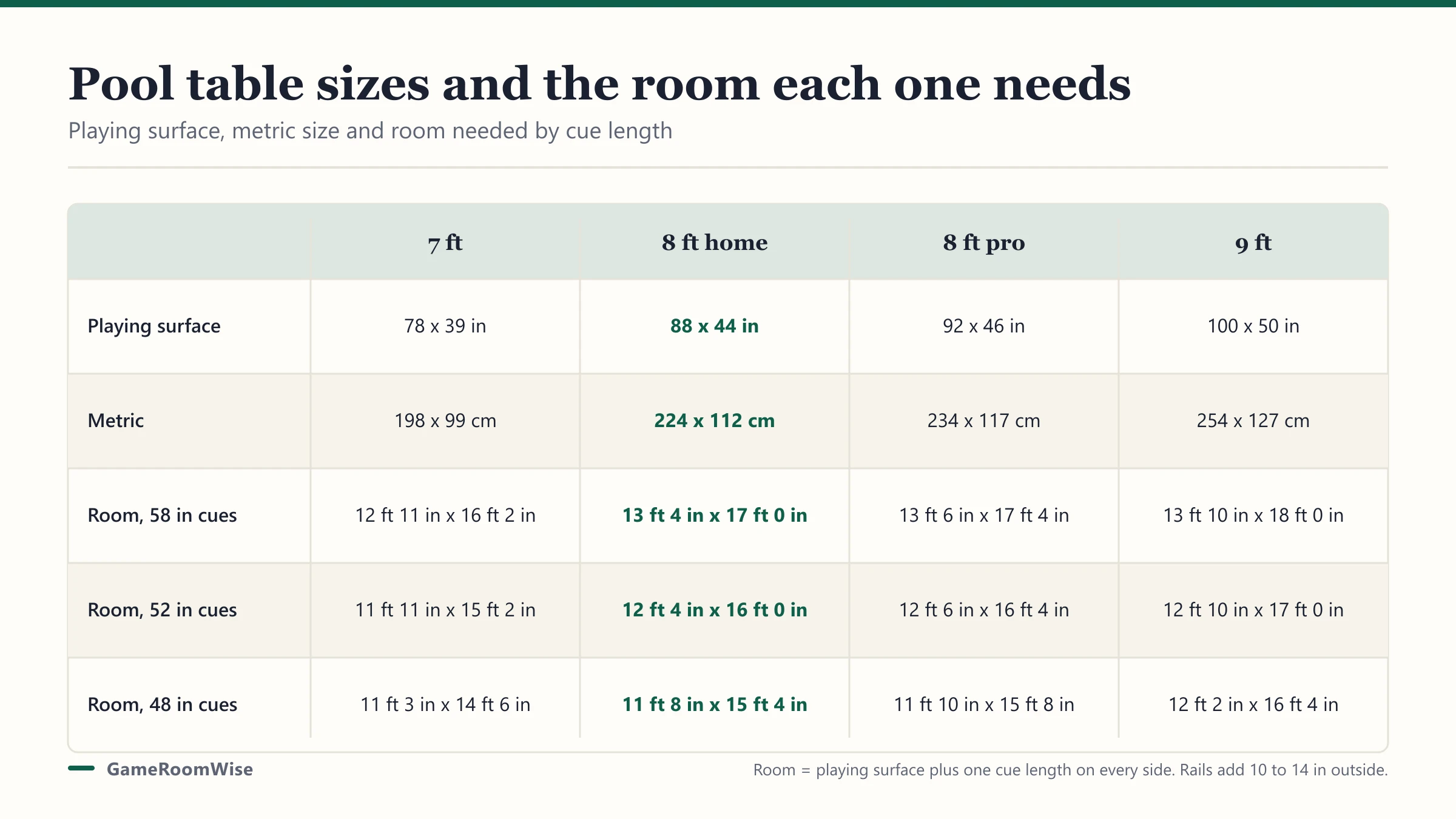
Each size needs its playing surface plus one cue length on every side, so the cue tip can reach the cushion while the butt clears the wall. These figures use the same math as our room planner:
| Table (playing surface) | 58 in cues | 52 in cues | 48 in cues |
|---|---|---|---|
| 7 ft (78 x 39 in) | 12 ft 11 in x 16 ft 2 in | 11 ft 11 in x 15 ft 2 in | 11 ft 3 in x 14 ft 6 in |
| 8 ft home (88 x 44 in) | 13 ft 4 in x 17 ft 0 in | 12 ft 4 in x 16 ft 0 in | 11 ft 8 in x 15 ft 4 in |
| 8 ft pro (92 x 46 in) | 13 ft 6 in x 17 ft 4 in | 12 ft 6 in x 16 ft 4 in | 11 ft 10 in x 15 ft 8 in |
| 9 ft (100 x 50 in) | 13 ft 10 in x 18 ft 0 in | 12 ft 10 in x 17 ft 0 in | 12 ft 2 in x 16 ft 4 in |
In metric, a home 8-foot table needs 4.06 x 5.18 m with 58 in cues and a 9-foot needs 4.22 x 5.49 m. Diamond publishes more generous minimums (14.5 x 18 ft for its 7-foot, 15 x 18.5 ft for its 8-foot, 15.5 x 19 ft for its 9-foot), which add 1 to 2 ft of elbow room over the cue math. To test a room with sofas, a bar or a second table in it, use the game room planner.
How much does each size weigh?
Slate tables weigh roughly 600 to 1,200 lb assembled, and weight climbs with size. Brunswick lists its 7-foot Allenton at 598 lb unpackaged. Diamond lists its 7-foot, 8-foot and 9-foot tables at 800, 1,000 and 1,200 lb.
Most of that is slate. At a specific gravity of about 2.8, a 1-inch slate bed the size of the playing surface alone weighs about 310 lb for a 7-foot, 390 lb for a home 8-foot and 505 lb for a 9-foot, before the slate that runs under the rails and the wooden backing. Non-slate tables weigh far less, which is one of the trade-offs covered in slate vs non-slate pool tables. Weight also decides whether a table can be moved in one piece: see how to move a pool table.
Which pool table size should you choose?
Choose by room first, then by how you play. If the room clears 13 ft 10 in x 18 ft 0 in, a 9-foot table is an option. If it clears 13 ft 4 in x 17 ft 0 in, a home 8-foot fits with full cues. Between those numbers and about 12 ft 11 in x 16 ft 2 in, pick a 7-foot, or an 8-foot with one short cue kept for the tight side.
- 9 ft: for players who compete or practise for tournaments, and rooms that clear it with full cues.
- 8 ft home: the default for family rooms; long enough for real position play.
- 7 ft: for smaller rooms and bar-style 8-ball. Shots are shorter, so games are quicker.
Who a full-size table is not for: rooms under about 11 ft x 14 ft 6 in, where even a 7-foot table with 48 in cues will not fit. A bumper pool table or a conversion-top setup is the honest answer there.
Where do these numbers come from?
- Playing surfaces, bed height, rail width, pocket mouths and ball size: World Pool-Billiard Association, Recommended Equipment Specifications (wpapool.com), read October 2026.
- 7-foot and snooker playing areas: Wikipedia, “Billiard table”, read October 2026.
- Outside dimensions, weights, room minimums and pocket sizes: brunswickbilliards.com, imperialusa.com and diamondbilliards.com product pages, read October 2026.
- Slate weight: our calculation from the playing-surface area at 1 in thick and a specific gravity of 2.7 to 2.9 (Wikipedia, “Slate”).
- Room sizes: playing surface plus two cue lengths on each axis, the method the room planner uses.
Frequently asked questions
Quick answers to what readers ask us most
What is the standard pool table size?
The tournament standard is the 9-foot table with a 100 x 50 in playing surface, set by the World Pool-Billiard Association. In American homes the most common size is the 8-foot table, whose playing surface is usually about 88 x 44 in.
How big is an 8 foot pool table?
A home 8-foot table plays on about 88 x 44 in and measures roughly 98 to 102 in by 54 to 58 in outside the rails (Brunswick's Glenwood 8 is 98.5 x 54.5 in, Imperial's Eliminator 102 x 58 in). A tournament or oversize 8-foot plays on 92 x 46 in and runs a few inches bigger outside.
How tall is a pool table?
The WPA puts the bed between 29.25 and 31 in above the floor. Measured to the top of the rails, home tables from Brunswick and Diamond list an overall height of 32 in.
What size room do I need for an 8 foot pool table?
With standard 58 in cues, a home 8-foot table (88 x 44 in) needs 13 ft 4 in x 17 ft 0 in. With 52 in cues it needs 12 ft 4 in x 16 ft 0 in. Try your own room in the room planner.
Is a 7 foot pool table too small?
Not for casual play. Seven-foot tables are the standard American bar size and the right call for rooms under about 13 x 16 ft. Players who want to practise for 9-foot league or tournament play will find the shorter shots on a 7-foot easier than the real thing.