
Dart Board Height and Distance: Setup in Five Measurements
Dart board height is 5 ft 8 in to the bull. Throw distance is 7 ft 9.25 in for steel-tip and 8 ft for soft-tip. The diagonal check, lane size and lighting.
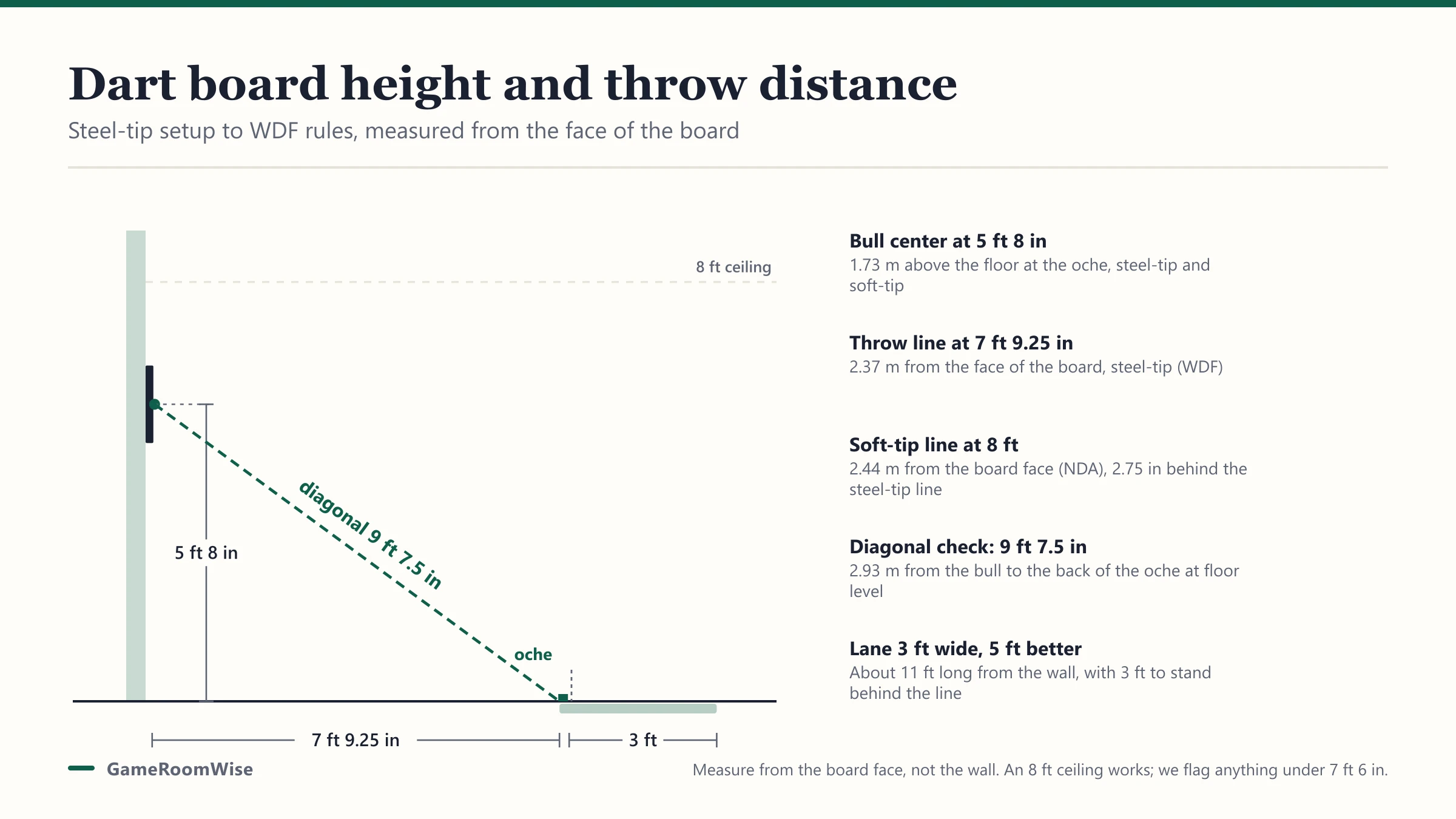
A dartboard setup comes down to five numbers: the height of the bull, the throw distance, a diagonal check, the width of the lane and the space behind the throw line. Get those right and every board in the house plays like a league board.
How high should a dart board be?
The center of the bullseye goes 5 ft 8 in (1.73 m) above the floor. The World Darts Federation rule measures from the floor at the level of the oche to a horizontal line through the center of the bull, and the National Dart Association uses the same 68 in for soft-tip.
Measure to the bull, not to the top or bottom of the board. A regulation bristle board is 451 mm (17.75 in) across, so its top edge ends up about 6 ft 4.9 in high and its bottom edge about 4 ft 11.1 in. If the floor under the throw line is raised, for example by a dart mat or a platform, measure from that surface. The WDF lets member darts bodies change board height for events for disabled players, so wheelchair players should check their own league’s number before drilling.
How far do you stand from a dart board?
Steel-tip players throw from 7 ft 9.25 in (2.37 m), measured along the floor from the face of the board. US soft-tip leagues under the National Dart Association throw from 8 ft (96 in, 2.44 m), measured from the face of the target to the front edge of the foul line.
| Measurement | Steel-tip (WDF) | Soft-tip (NDA) |
|---|---|---|
| Bull center above floor | 5 ft 8 in (1.73 m) | 5 ft 8 in (1.73 m) |
| Throw distance from board face | 7 ft 9.25 in (2.37 m) | 8 ft (2.44 m) |
| Diagonal, bull to oche at floor | 9 ft 7.5 in (2.93 m) | about 9 ft 9.6 in (2.99 m), our calculation |
| Raised oche (if used) | 38 mm high, 610 mm long (1.5 x 24 in) | Not specified |
The WDF number is itself a compromise: Wikipedia’s darts entry notes that the 2.37 m distance settled a split between the UK and other countries that threw from different lengths. If your house plays both board types, mark both lines on the floor; they sit 2.75 in apart.
How do you check the setup with the diagonal?
Measure from the center of the bull straight down and out to the oche: for steel-tip it should read 9 ft 7.5 in (2.93 m) to the back of the oche at floor level, per the WDF rules. If the height and distance are right, the diagonal will be too.
The diagonal catches the two common errors at once. If the board hangs too high, the diagonal reads long. If the line was measured from the wall instead of the board face, it reads short. For a soft-tip line at 8 ft with the bull at 68 in, the same check comes to about 9 ft 9.6 in (2.99 m). A tape measure held by two people is enough; one person holds the end on the bull while the other reads it at the floor.
How wide and long should a dart lane be?
Plan on a lane at least 3 ft wide, with 5 ft more comfortable, and about 11 ft long from the wall. The length is the board’s depth off the wall (about 1.5 in for a bristle board on a bracket), the throw distance, and 3 ft of standing room behind the line.
| Lane | Steel-tip | Soft-tip |
|---|---|---|
| Board face to throw line | 7 ft 9.25 in | 8 ft |
| Standing room behind the line | 3 ft | 3 ft |
| Total from wall (bristle board) | about 10 ft 10.75 in | about 11 ft 1.5 in |
| Lane width | 3 ft minimum, 5 ft recommended | 3 ft minimum, 5 ft recommended |
Under WDF tournament rules, an opponent stands at least 60 cm (about 2 ft) behind the player at the oche, which is why 3 ft behind the line is a sensible home minimum. Keep the lane out of any walkway, door swing or pool cue zone: the game room planner flags a walkway that crosses a dart lane.
How high does the ceiling need to be for darts?
A standard 8 ft ceiling works. We flag anything under 7 ft 6 in (90 in), which leaves only 22 in above the bull for a dart thrown with a high arc. Low basement ceilings with ducts or beams in the throwing path are the usual problem.
Check also what is above and behind the board. Pipes, ducts and wiring in the wall behind it should be out of the area a missed dart can reach; a board surround or cabinet protects the wall and stops most misses. Hang the board on a solid wall, not on a door, since closing the door shakes the board and anyone walking through stands in the line of fire.
How should you light a dartboard?
Light the board from in front and above so the darts do not throw shadows across the segments. The WDF requires at least two light fittings of 1,600 lumens (100 W) minimum for stage finals, screened so no light shines into the eyes of a player standing at the oche.
At home that means one of two setups. A ring light that mounts around the board gives even, shadow-free light from all sides and is the simplest fix. Two spotlights angled from either side of the throw line do the same job without hardware on the board. A single ceiling light behind the player throws the player’s own shadow onto the board and is the setup to avoid. For electronic boards with lit displays, the same rule holds: light the segments, not the player’s face.
How do you protect the floor and wall?
Put a dart mat or a hard, replaceable surface under the throw zone, and a surround around the board. Steel tips that drop point-first dent hardwood and tear carpet, and a mat that runs from the wall to at least the throw line catches nearly all of them.
Some mats come with throw lines printed on them, which saves measuring. Check the printed distances against the numbers above and against your board’s depth off the wall: a line printed for a bristle board on a bracket will be wrong by the cabinet depth if your board sits in a cabinet. Soft-tip darts are gentler on floors, but they can bounce out of an electronic board, so a mat is still worth having. Board choice, including cabinets and surrounds, is covered in our best dart boards guide.
How do you mount a dartboard step by step?
Mount the bracket so the bull lands at 68 in, then measure the throw line from the board face. In order:
- Find a solid section of wall and check for wires and pipes behind it.
- Mark a point 68 in above the floor; that is where the bull’s center must sit.
- Measure from the bracket’s position on the back of your board to the bull’s center, and fix the bracket that distance above or below your mark.
- Hang the board with the 20 segment at the top, and check it is level and does not rock.
- Drop a plumb line from the board face to the floor and measure 93.25 in (steel-tip) or 96 in (soft-tip) from it. Mark the line.
- Check the diagonal: 9 ft 7.5 in for steel-tip.
Who this setup is not for: anyone who cannot give the board a dedicated lane. A board in a hallway or next to a door will eventually put a dart into someone. If the game room is tight, look at how the lane fits next to a pool or ping pong zone in our pool table sizes and ping pong table dimensions guides before you drill.
Where do these numbers come from?
- Board height, throw distance, diagonal, raised oche, opponent position and lighting: World Darts Federation, Playing and Tournament Rules, 20th revised edition (28 February 2018), sections 5 and 6 and clause 14.06, read October 2026 on dartswdf.com.
- Soft-tip throw distance and height: National Dart Association equipment specifications, ndadarts.com, read October 2026.
- Board diameter and the history of the 2.37 m distance: Wikipedia, “Darts” and “Dartboard”, read October 2026.
- Soft-tip diagonal, board edge heights and lane lengths: our calculation; the 7 ft 6 in ceiling flag and lane widths are the planning values used by the room planner.
Frequently asked questions
Quick answers to what readers ask us most
How high should a dart board be?
The center of the bullseye should be 5 ft 8 in (1.73 m) above the floor. That is the World Darts Federation rule and the National Dart Association soft-tip rule, so the height is the same for steel-tip and electronic boards.
How far do you stand from a dart board?
For steel-tip darts, stand behind a line 7 ft 9.25 in (2.37 m) from the face of the board. For soft-tip darts in US leagues, the line is 8 ft (2.44 m) from the board face. Measure along the floor from a plumb line dropped from the board face.
What is the diagonal distance for a dart board?
For steel-tip, 9 ft 7.5 in (2.93 m) from the center of the bull to the back of the oche at floor level. For soft-tip at 8 ft, the same check works out to about 9 ft 9.6 in (2.99 m).
How much space do you need for a dart board?
Plan on a lane about 11 ft long from the wall and at least 3 ft wide, with 5 ft more comfortable. The room planner places a dart lane alongside other tables.
Is the dart board distance measured from the wall?
No. Both the WDF and the NDA measure from the face of the board. Electronic boards and boards in cabinets stand further off the wall than a bristle board on a bracket, so measuring from the wall puts the line too close.