
Poker Table Buying Guide: Size, Shape, and Build
How to choose a poker table: oval, round and octagon sizes, how many each seats, speed cloth and padded rails, convertibles, and the room you need.
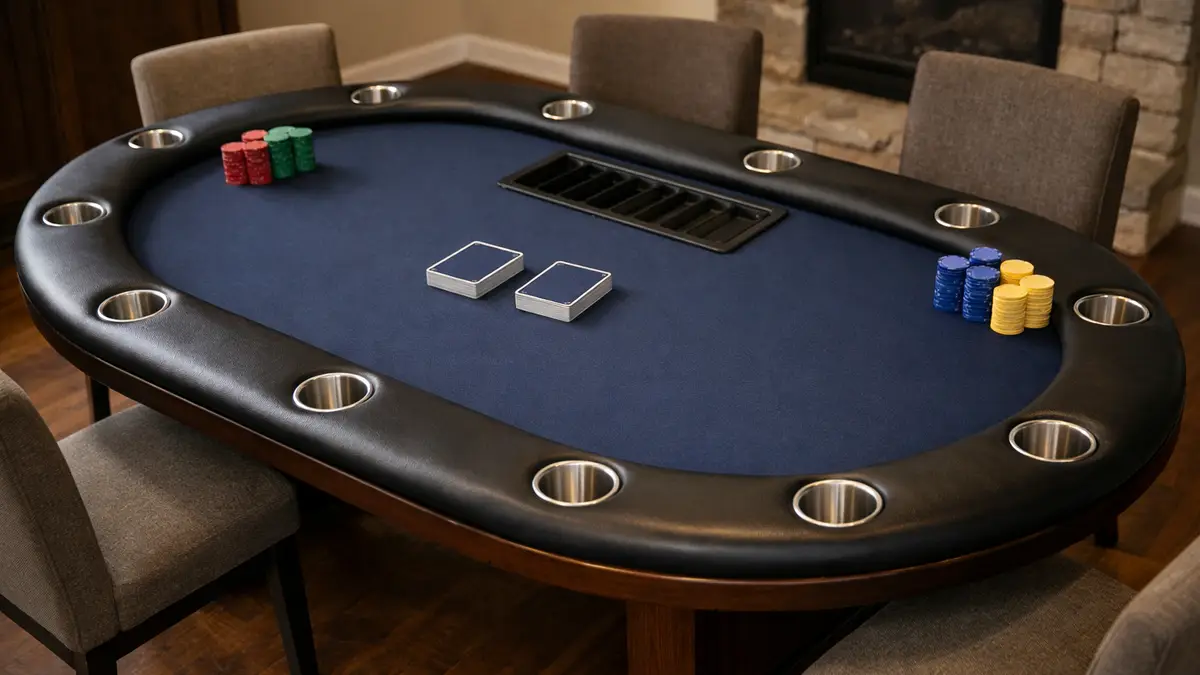
A poker table is chosen the same way as any game room table: by the group it seats and the room it fits, then by build. The seat-count numbers on listings are the easy part; the number that decides whether it fits is the room you need once chairs are pulled out. This guide covers both.
What size and shape of poker table should you buy?
Match the shape to your usual group. Oval tables seat the most and suit a regular 8-to-10 player game; round and octagon tables seat up to 8 and fit a smaller room; compact tables suit 6. The playing surface should leave each player room for cards, chips and a drink.
| Shape | Typical size | Seats | Best for |
|---|---|---|---|
| Oval (racetrack) | 84 to 96 in long, 42 to 44 in wide | 8 to 10 | Regular full games, a dealer spot |
| Round | 48 to 55 in diameter | 6 to 8 | Smaller rooms, casual groups |
| Octagon | 48 to 54 in across | 6 to 8 | Fixed seat positions, home games |
| Compact / folding | 48 in | 6 | Occasional play, storage |
An oval table usually includes a marked dealer position and sometimes a sunken chip tray or a dealer tray, which a round table may not. If your game runs a rotating dealer, the oval’s layout helps; a pure home game among friends does fine on a round or octagon.
How much room does a poker table need?
Add about 2 ft per seated player around the table for chairs and pulling back. A 96 in oval that seats 10 needs a room near 12 x 8 ft once chairs are out; a 55 in round needs about 8 x 8 ft. Players need to push back and stand without hitting a wall.
The room math is the same idea as every table in our game room size guide: the footprint plus the clearance people use. Plan it in the game room planner before buying, because a table that seats 10 on paper is miserable in a room that only clears chairs for 6. Leave a clear path to one side so a player can leave mid-game without everyone shifting.
What build features matter?
Four features separate a table that lasts years of game nights from one that frays in a season:
- A padded rail. A vinyl-wrapped, foam-padded armrest around the edge makes long sessions comfortable and is the first thing to wear out on cheap tables.
- The playing surface. Speed cloth (a tight, slick weave) lets cards slide and chips stack cleanly; standard felt is softer and slower and shows wear faster.
- Cup holders. Recessed stainless holders keep drinks off the surface. Count them against your seat number.
- The frame and legs. A solid wood or steel frame with folding or removable legs holds up better than a thin particleboard shell.
A good surface is the difference between cards that glide and cards that catch, so if you buy one upgrade, make it the cloth.
Should you get a dedicated table or a convertible?
It depends on how often you host and how much space you can give up full-time. A dedicated table is more comfortable and more durable; a convertible or folding table earns its place when the room has another job.
| Type | Build and comfort | Storage | Best if you host |
|---|---|---|---|
| Dedicated table | Best rail, surface and frame | Stays up full-time | Weekly or most weeks |
| Dining-top convertible | Poker surface under a dining top | Doubles as a dining table | A few times a month |
| Folding table | Fair rail, folds flat | Stores against a wall | Occasionally |
| Tabletop / mat | Lay over any table | Rolls or stacks away | Rarely, or for travel |
A dining-top convertible is the game-room cousin of the pool table dining tables idea: one surface, two uses, so the room is not given over to a single game. Groups that also play cards and board games should look at a felt-topped board game table or a multi-game table that includes a poker layer.
What does a good poker table cost?
Price tracks build quality and whether the table folds. A padded tabletop that lays over a dining table is the cheapest way in; a folding table adds legs and a frame; a dedicated oval with a solid frame, speed cloth and a dealer tray costs the most. The ranges below are typical October 2026 retail.
| Type | Rough price (Oct 2026) | What you get |
|---|---|---|
| Tabletop / mat | $30 to $120 | Felt or speed-cloth surface, no legs |
| Folding table | $120 to $350 | Padded rail, cup holders, folds flat |
| Dining-top convertible | $400 to $1,500 | Poker surface under a removable dining top |
| Dedicated oval | $600 to $3,000+ | Solid frame, dealer position, premium cloth |
Spending more buys durability and comfort, not a better game: a $120 folding table plays the same hand as a $2,000 oval. The upgrade you feel most is the surface and the rail, which is where a cheap table fails first. If budget is tight, a mid-price folding table with a real padded rail beats a bare dedicated table with a thin one.
What accessories should you budget for?
The table is the start; a working home game needs a few more pieces. A quality chip set (300 to 500 chips for a full table), two decks of plastic-coated playing cards, and a dealer button are the minimum. A cut card and a card shuffler are optional conveniences.
Lighting matters more than people expect: a game room light placed too high or off-center casts shadows across the felt and tires eyes over a long session, so a fixture centered over the table at a sensible height is worth planning. Seating is the other budget line, since poker is a sitting game played for hours; comfortable chairs with a little back support keep players at the table. Groups that rotate between games should look at a multi-game table or a felt board game table so the poker surface is not the only thing the room does.
Who should skip a dedicated poker table?
Anyone who hosts a few times a year should not give a room over to a full oval that sits unused between games. A folding table, a dining-top convertible, or a padded tabletop that lays over an existing table delivers most of the experience and stores away. A dedicated table pays off for the regular host with the floor space to leave it standing, where the better rail, surface and frame are worth the room they take. Decide by how many real game nights a year you host, not by how many you imagine.
Where does this guidance come from?
- Table shapes, sizes and seat counts: common poker-table retail specifications, read October 2026.
- Room clearance: table size plus per-seat chair room, the same method as our game room size guide and the room planner.
- Build features (speed cloth, padded rail, cup holders, frame): standard product descriptions across home poker-table makers, read October 2026.
Frequently asked questions
Quick answers to what readers ask us most
What size poker table do I need?
Match the shape to your group. An oval 84 to 96 in table seats 8 to 10, a 55 in round seats up to 8, a 48 in round or octagon seats 6 to 8, and a small 48 in round is tight at 6. Add about 2 ft per seat for chairs when checking the room.
How many people fit at a poker table?
A standard oval tournament-style table seats 8 to 10 with a dealer position, a 55 in round or octagon seats about 8, and a 48 in table seats 6 comfortably. Crowding more players in leaves no room for chips and cards in front of each seat.
What should I look for in a poker table?
A padded armrest rail, a smooth playing surface in speed cloth or felt, cup holders, a solid frame or legs, and a size that fits your group and room. Dining-top and folding models add versatility. Avoid thin tabletop-only mats if you host regularly.
Is a folding poker table or a dedicated table better?
A folding table or tabletop is better if you host occasionally and need to store it; a dedicated table is better if you host regularly and have the space, because the build, rail and surface are more durable and comfortable for long sessions.