
Table Tennis Rules: Scoring, Serving, and Faults
Table tennis rules made simple: games to 11, two serves each, the legal serve toss, let serves, doubles order and the faults that lose a point under ITTF law.
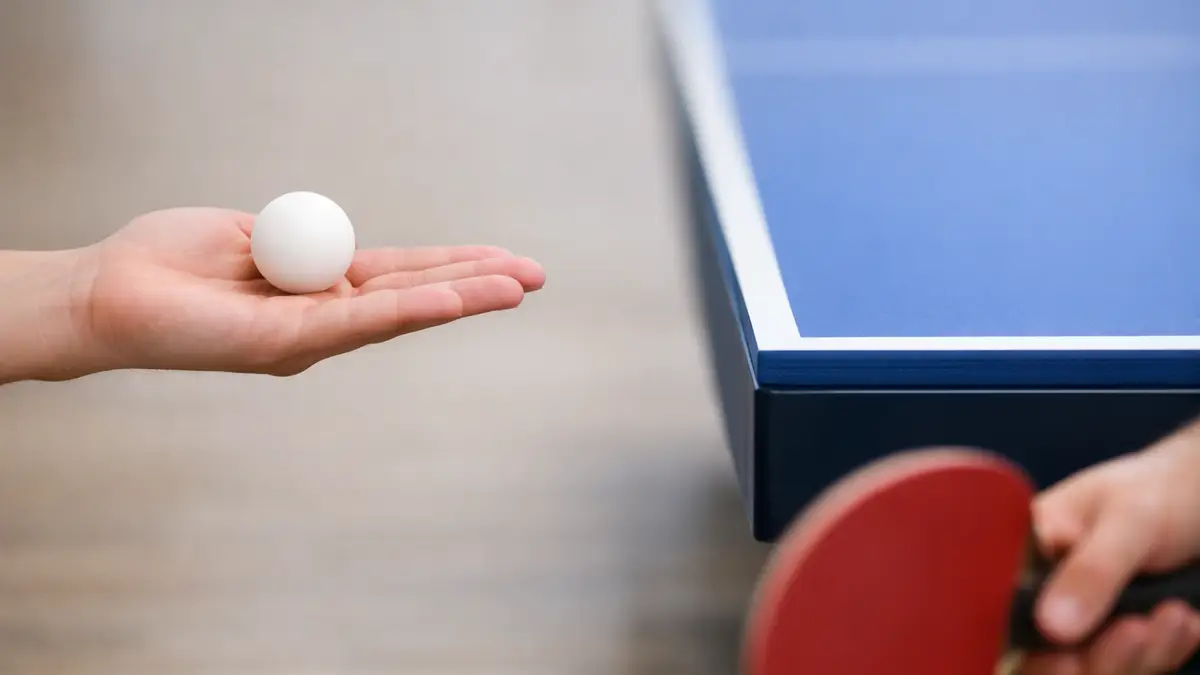
Most table tennis arguments come from two places: casual players still scoring to 21, and serves that would never pass in a league. This page gives the current ITTF rules, the 11-point game and the legal serve first, then the faults and doubles order that decide close points.
How does scoring work in table tennis?
A game is the first player to 11 points, and you must win by 2. At 10-10 the game goes to deuce and continues until someone leads by 2, so 12-10, 13-11 and longer scores are all normal. A match is a best-of series of games, usually best of 5 (first to 3 games) or best of 7 (first to 4).
You score a point on every rally, whether you served or not; this is rally scoring, not the old serve-only scoring. The 21-point game many people grew up with was retired by the ITTF in 2001. If a casual group prefers 21, that is a house rule, not the current law.
| Format | Points to win a game | Serve change |
|---|---|---|
| Modern ITTF | 11, win by 2 | Every 2 points |
| At deuce (10-10) | Lead by 2 | Every 1 point |
| Old pre-2001 | 21, win by 2 | Every 5 points |
What makes a legal serve?
The serve is where most home players break the rules without knowing it. Under ITTF law the ball starts resting on your open, flat, still palm above the table and behind the end line. You toss it at least 16 cm (about 6 in) nearly vertically, then strike it as it falls.
The ball must bounce once on your own side, then once on the opponent’s side. You cannot hide the ball with your free arm or body; the receiver must see the whole serve. Serve alternates every 2 points, and in singles the ball may land anywhere on the far side.
Common serve faults that lose the point:
- Tossing the ball less than 16 cm, or not tossing it at all (a sling serve).
- Holding the ball with fingers curled rather than on a flat palm.
- Striking the ball before it reaches the top of the toss, or below the table.
- Hiding the contact point from the receiver.
A better paddle will not fix a faulty serve, but the right rubber helps spin serves bite. Our best ping pong paddles guide covers rubber grades.
What is a let, and when do you replay a point?
A let is a point that is replayed with no score change. The common one is the net serve: if your serve clips the top of the net but otherwise lands legally on the opponent’s side, it is a let and you serve again. There is no limit on how many lets in a row can happen.
Play also stops for a let if the receiver was not ready, if the ball is damaged mid-rally, or if something outside interferes with play. During a rally, a shot that touches the net and still lands in is live and in play; the net only forces a replay on the serve.
Which faults lose a point in a rally?
You lose the point when you fail to make a legal return or break a rule during the rally. The clear ones:
- The ball bounces twice on your side.
- You fail to return the ball over or around the net onto the opponent’s side.
- You hit the ball twice in a row, or your free hand touches the table surface.
- You move the table or the ball touches anything you are wearing.
- You strike the ball before it bounces on your side (volleying is not allowed).
A ball that hits the top edge of the playing surface is in; one that strikes the vertical side below the surface is out. For the exact table, net and line dimensions behind these calls, see our ping pong table dimensions guide.
How do the rules change for doubles?
Doubles adds a serving order and a diagonal serve. The serve must travel from the server’s right half, cross-court, to the receiver’s right half; a serve to the wrong half loses the point. In singles there is no such restriction.
Partners must also alternate hitting the ball. Once the serve is returned, the four players strike the ball in a fixed rotation, and hitting out of turn loses the point. Service rotates through all four players as the game progresses, and the pairing swaps the receiver each time service changes. A full-size table handles four players, but the room needs the run-back from our table dimensions guide; check yours in the game room planner.
How do you decide who serves first?
The choice of first service is settled before play, usually by a toss or by hiding the ball in one hand for the opponent to guess. The winner of that choice may elect to serve first, to receive first, or to pick an end; the loser takes whatever is left.
In the next game of a match, the player who received first in the previous game serves first, and the ends switch each game. In the deciding game of a match, the players change ends when the first player reaches 5 points. These rotation rules keep any advantage from the serve or the room from favoring one side across a full match.
What equipment rules apply at home?
Casual play is forgiving, but a few equipment rules are worth knowing. The ball is 40 mm and weighs 2.7 g, and competition balls are white or orange with a matte finish so they are easy to track. The racket (paddle) has no size limit, but the two sides must be different colors, traditionally red and black, so the opponent can read which rubber you are using on a shot.
The table surface should give an even bounce, which is why a thin or warped top produces dead spots that make fair rallies hard. None of this is enforced in a basement game, but if you are setting up for a club or a ladder, matching the ball color to the lighting and using a two-color paddle removes the most common sources of dispute. Paddle grades and rubber types are covered in our best ping pong paddles guide, and table-top quality in our best ping pong tables guide.
Who these rules are not for
Players entering a sanctioned tournament should read the current ITTF Laws of Table Tennis in full, because this is a summary and the law covers equipment checks, timeouts, the expedite rule for long games, and umpire procedures this page leaves out. For home and club play, the scoring, serve and fault rules above are the ones that settle real points. If you only play casual doubles for fun, agree on the serve-visibility rule before you start, since the hidden serve is the single biggest source of friction on a home table.
Where do these rules come from?
- Scoring, serving, lets, faults and doubles order: the ITTF Laws of Table Tennis, as summarized in the Wikipedia “Table tennis” entry and the ITTF handbook summary, read October 2026.
- The 2001 change from 21 to 11 points: the same sources.
- Table and net specifications referenced for edge and net calls: our ping pong table dimensions guide.
Frequently asked questions
Quick answers to what readers ask us most
How many points do you need to win in table tennis?
A game is first to 11 points and you must win by 2. If the score reaches 10-10, play continues until one player leads by 2. A match is usually best of 5 or best of 7 games. The old 21-point game is no longer the official format.
What are the rules for serving in table tennis?
The ball rests on your open, flat palm, you toss it at least 16 cm (about 6 in) nearly straight up, and strike it behind the end line so it bounces once on your side then your opponent's. Serve changes every 2 points. The whole toss and hit must be visible to the receiver.
Does a serve have to go diagonally in table tennis?
Only in doubles, where the serve must go from the server's right half to the receiver's right half (diagonally). In singles the ball can land anywhere on the opponent's side as long as it bounces once on each side.
Is a ball that hits the edge of the table in or out?
A ball that hits the top edge of the playing surface is in. A ball that strikes the vertical side of the table below the surface is out. The edge ball is one of the most argued calls in casual play, but the rule is clear.