
Darts Rules: How to Play 501, Cricket, and Scoring
Darts rules explained: how 501 double-out works, how the board scores, the bust rule, and how to play Cricket at home with steel-tip or soft-tip darts.
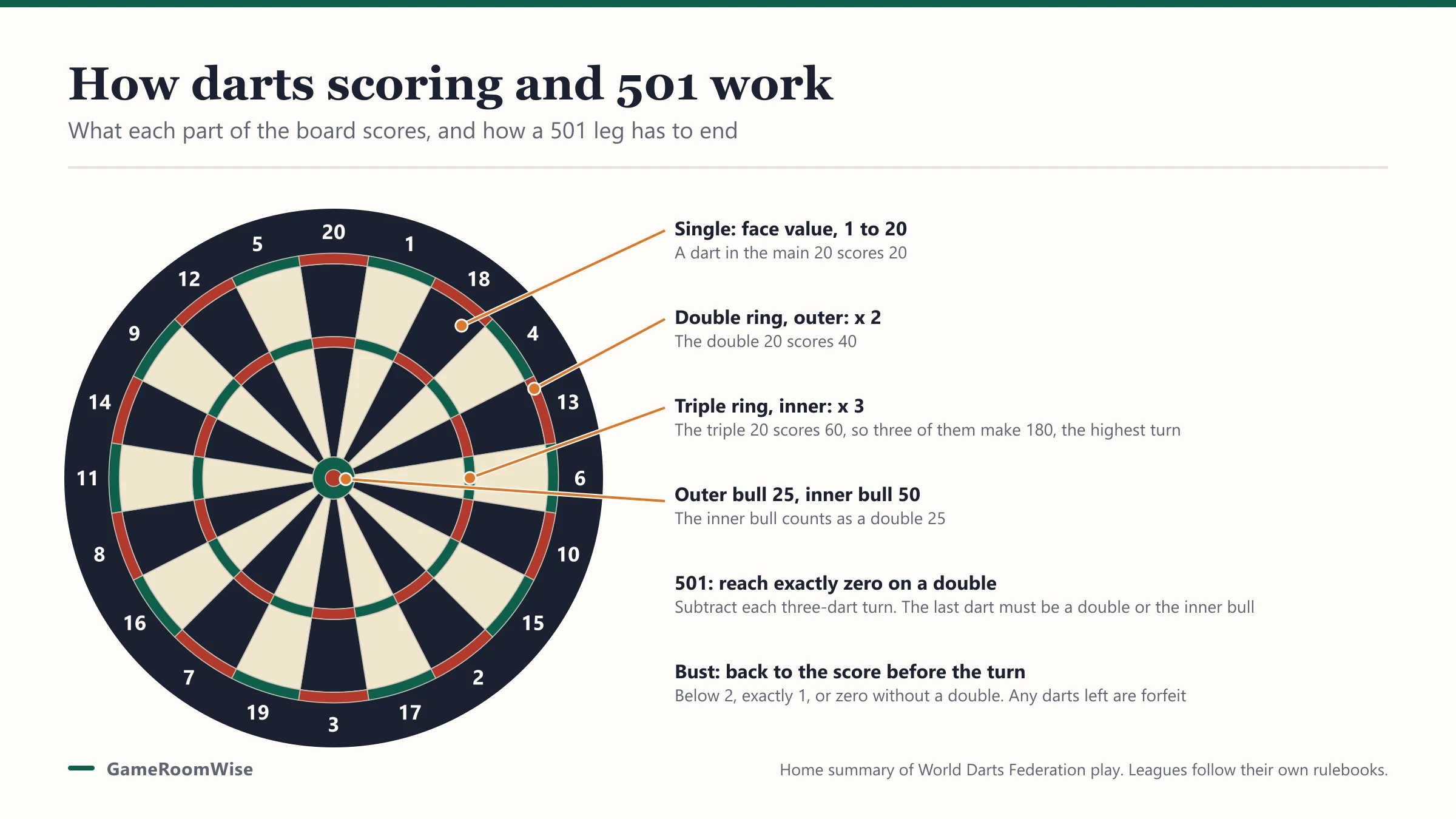
Darts has one game nearly everyone plays, 501, and one rule inside it that decides most legs: the double-out finish. This page explains 501 and the bust rule first, then Cricket and a casual warm-up game, with the steel-tip and soft-tip differences that matter at home.
How do you score on a dartboard?
Each of the 20 numbered segments scores its face value when a dart lands in the large area. The thin ring at the outer edge of the scoring area doubles that number, and the thin ring partway in triples it. The outer bull scores 25 and the inner bull scores 50.
So a dart in the main 20 scores 20, the triple 20 scores 60, and the double 20 scores 40. Three triple 20s is 180, the highest possible three-dart score. The inner bull counts as a double 25, which matters for finishing a 501 leg.
| Target | Score |
|---|---|
| Single segment | Face value (1 to 20) |
| Double ring (outer) | Face value x 2 |
| Triple ring (inner) | Face value x 3 |
| Outer bull | 25 |
| Inner bull | 50 (counts as double 25) |
| Highest three-dart turn | 180 (three triple 20s) |
How does 501 work?
Both players start on 501. You throw three darts per turn, add them up, and subtract the total from your running score. The aim is to reach exactly zero before your opponent, and the dart that takes you to zero must be a double or the inner bull.
Here is a short finish. You are on 40. You throw at double 20 (worth 40) and hit it: you are on zero with a double, and you win the leg. If instead you were on 32, you aim for double 16; miss into the single 16 and you drop to 16, then try double 8, and so on. Planning the finish is half the game, which is why players memorize common checkouts.
What is the bust rule?
A turn busts if your score goes below 2, lands exactly on 1, or reaches zero on a dart that is not a double. When you bust, your score returns to whatever it was at the start of that turn, and any darts left in the turn are forfeit.
The bust rule is why you cannot just subtract blindly. From 18 you cannot throw at the 20, because scoring 20 would put you at minus 2; and you cannot leave yourself on 1, because 1 cannot be finished with a double. Good players steer their score toward an even number they can halve into a double, such as 40, 32 or 16.
How do you play Cricket?
Cricket uses only the numbers 15, 16, 17, 18, 19, 20 and the bullseye. You “close” a number by hitting it three times, where a double counts as two hits and a triple as three. Once you have closed a number that your opponent has not, every further hit on it adds its value to your score.
You win by closing all seven targets while holding a score equal to or higher than your opponent’s. Cricket rewards accuracy across the board rather than one hot number, so it suits mixed-skill groups better than 501, where a strong player can run away with the leg.
| Feature | 501 | Cricket |
|---|---|---|
| Targets used | Whole board | 15 to 20 and bull |
| Skill it rewards | Finishing and checkout math | All-around accuracy |
| Good for | Head-to-head, league | Mixed-ability groups |
| Finish condition | Exact zero on a double | Close all targets with the lead |
What casual games can beginners start with?
Around the Clock is the simplest starter. Players take turns trying to hit each number in sequence, from 1 up to 20 and then the bull; the first to clear the sequence wins. It teaches board familiarity without checkout math.
Halve It is another gentle game: you aim for a set target each round, and missing it halves your score, which keeps every player in the game longer. These are the games to start new or young players on before moving them to 501. Whichever game you play, the board must be hung and the throw line set correctly, which our dart board height and distance guide covers, and the lane needs the floor space in our game room size guide.
How do you keep score and set up a match?
Scores are tracked on a chalkboard, a dry-erase board or the electronic board itself. In 501, you write each player’s starting 501 and subtract each turn’s total, so the running number is what remains to finish. In Cricket, you mark each closed number and tally points beside it.
A match is built from legs and sets. A leg is a single game of 501; a set is a group of legs, often best of 3 or best of 5. Casual home play usually runs single legs or best of 3, while league and televised play stack legs into sets. Agree on the format and who throws first (decided by each player throwing one dart at the bull, closest wins) before the first full turn.
| Term | Meaning |
|---|---|
| Leg | One complete game (for example, one 501 from 501 to zero) |
| Set | A group of legs, often best of 3 or 5 |
| Checkout | The combination of darts that finishes a leg on a double |
| Ton | A score of 100 in a single turn; 180 is the maximum |
What common checkouts should you learn?
A checkout is the three-dart (or fewer) finish that takes you from your remaining score to exactly zero on a double. Learning a handful removes the math pressure at the end of a leg, where most casual players lose by busting. The reliable ones:
- 40: aim double 20. Miss into single 20 leaves 20, then double 10.
- 32: aim double 16. Miss into single 16 leaves 16, then double 8.
- 36: aim double 18. Miss into single 18 leaves 18, then double 9.
- 50: the inner bull finishes it directly.
The pattern is to steer your score toward an even number you can halve repeatedly, which keeps a double in reach after a miss. Leaving yourself on an odd number like 29 means you must score a single first to set up a double, costing a dart. Players who finish well think a turn ahead, aiming not just to score but to leave a friendly checkout number.
Do steel-tip and soft-tip change the rules?
The games are the same; the equipment and some finishes differ. Steel-tip darts are thrown at a bristle board from 7 ft 9.25 in, and scoring is kept by the players or a chalker. Soft-tip darts are thrown at an electronic board from 8 ft, and the machine scores automatically.
Electronic boards often default to “master out” or “double out” settings you can change in the menu, and some run a single-bull-only mode. Before a soft-tip match, check the board’s out setting so both players know whether a double is required. Board and dart choice is covered in our best dart boards and best darts guides.
Who these rules are not for
Players entering a steel-tip league or a PDC-style event should follow that body’s rulebook, which fixes the leg and set format, the throw order, and the handling of bounce-outs and disputed darts in ways a home summary does not. This page is for home play, where the double-out finish in 501 and the closing rule in Cricket are the two things a group needs to agree on before the first throw.
Where do these rules come from?
- Board scoring, 501 play, the double-out finish and the bust rule: the World Darts Federation playing rules, as summarized in the Wikipedia “Darts” and “Games played with darts” entries, read October 2026.
- Cricket, Around the Clock and Halve It: the same sources.
- Throw distance and board height: our dart board height and distance guide.
Frequently asked questions
Quick answers to what readers ask us most
How do you play 501 darts?
Both players start on 501. You throw three darts a turn and subtract the total from your score. You must reach exactly zero, and the final dart must land in a double (the outer ring) or the bullseye. The first player to finish on a double wins the leg.
What is the bust rule in darts?
If a turn takes your score below 2, lands you exactly on 1, or hits zero without a double, the turn busts. Your score goes back to what it was at the start of that turn, and the remaining darts of the turn do not count.
How does the dart board score?
Each numbered segment scores its face value. The thin outer ring doubles it and the thin inner ring triples it. The outer bull scores 25 and the inner bull scores 50, which counts as a double 25. The highest three-dart score is 180, from three triple 20s.
How do you play Cricket in darts?
Cricket uses only the numbers 15 through 20 and the bullseye. You close a number by hitting it three times, counting doubles and triples. Once you have closed a number and your opponent has not, extra hits on it score points. The winner closes everything with the lead or tied score.