
Foosball Table Dimensions: Size, Height, and Room
Standard foosball table dimensions: cabinet about 56 x 30 in and 36 in high, playfield near 47 x 27 in, plus rod travel, the room needed and how brands differ.
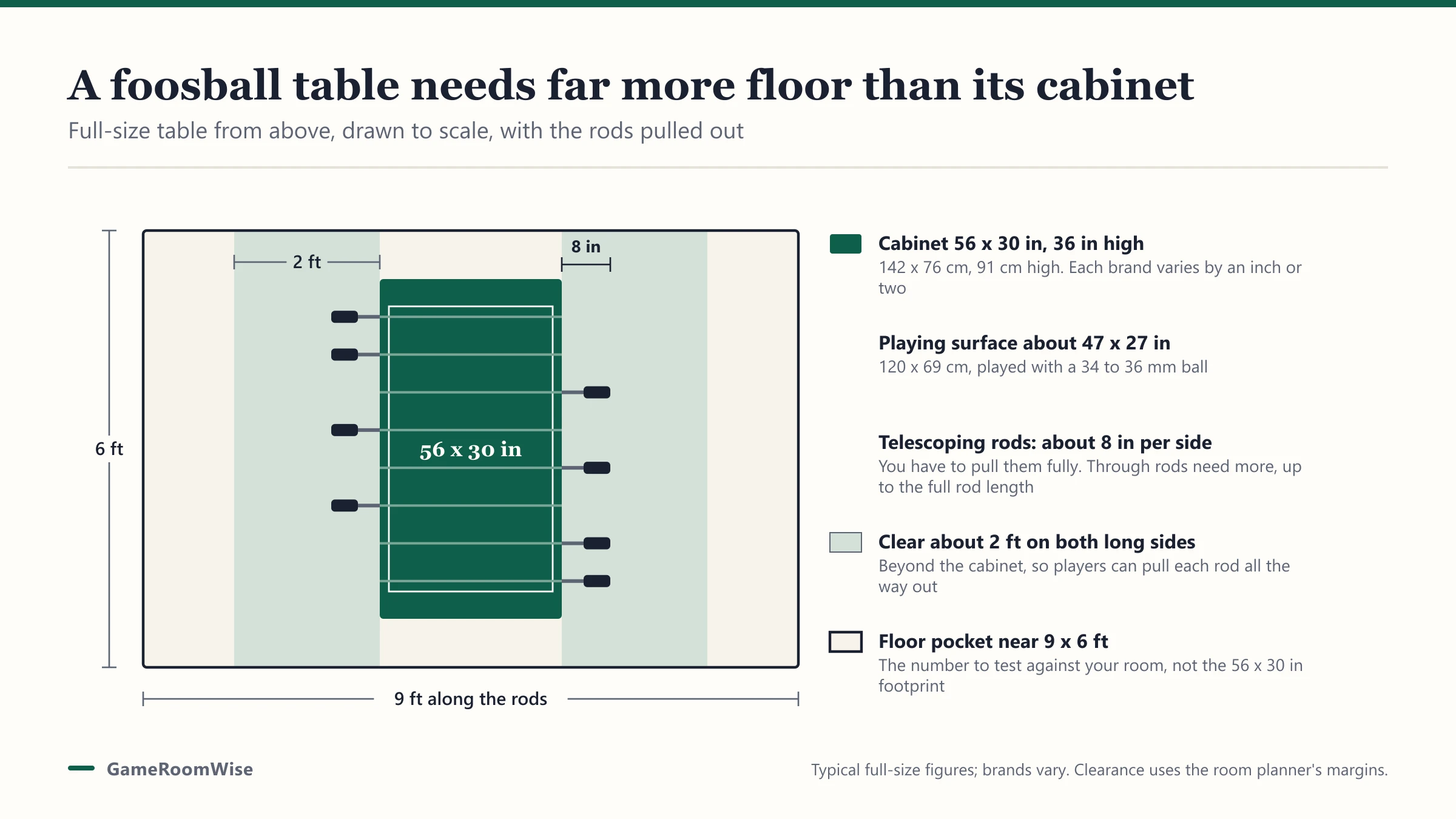
A full-size foosball table is close to a standard size, but the number that decides whether it fits is not on the box: it is the rod travel. The rods slide out past the cabinet when you play, so the room has to be wider than the table. This page gives the cabinet and playfield sizes, then the clearance you actually need.
What are the standard foosball table dimensions?
A full-size foosball cabinet is about 56 in long, 30 in wide and 36 in high to the top of the cabinet. The playing surface inside is roughly 47 to 48 in by 27 in. These are typical home and competition numbers; each brand varies by an inch or two.
| Dimension | Typical full-size |
|---|---|
| Cabinet length | 56 in (142 cm) |
| Cabinet width | 30 in (76 cm) |
| Cabinet height | 36 in (91 cm) |
| Playing surface | about 47 x 27 in (120 x 69 cm) |
| Ball diameter | 34 to 36 mm |
| Weight | about 150 to 355 lb by build |
The height puts the handles at standing height for most adults, which is why foosball is played standing. The weight range is wide because a solid-cabinet competition table is far heavier than a flat-pack home model, and the heavier table shifts less during hard play. Model-by-model build quality is in our best foosball tables guide.
How much room does a foosball table need?
Add rod travel to each side, then standing room at each end. On most tables the telescoping rods pull out about 8 in per side, and you need to pull them fully, so leave about 2 ft of clear space beyond the cabinet on both long sides. Players also stand at each end, so leave room there too.
A 56 x 30 in cabinet therefore wants a floor pocket near 9 ft (along the rods) by 6 ft. That is the number to test against your room, not the 56 x 30 in footprint. Non-telescoping rods, which slide all the way through, need even more side clearance, up to the full rod length, so telescoping rods are the better choice in a tight room. Plan the pocket in the game room planner, and see how it fits beside other tables in our game room size guide.
How do Tornado, Garlando and Bonzini differ?
The three best-known competition brands are close in cabinet size but differ in build, player count and handle feel, which changes both the game and the exact footprint. The figures below are approximate full-size cabinet sizes; confirm against each maker’s current listing before you plan a room.
| Brand | Style | Approx. cabinet | Notable trait |
|---|---|---|---|
| Tornado | American | about 56 x 30 in | Counterbalanced men, heavy cabinet |
| Garlando | European/Italian | about 56 x 30 in | Telescopic rods, popular in home and club play |
| Bonzini | French | about 56 x 30 in | Linoleum playfield, hand-painted aluminum players, slower game |
American Tornado-style tables suit a fast, hard-shot game. European tables such as Garlando and the French Bonzini tend toward a control game with different ball and surface behavior. The cabinet footprint is similar across all three, so the room math above holds, but the handle length and rod travel can differ by an inch or two.
What size are tabletop and kids’ foosball tables?
Tabletop foosball sets are much smaller, often 20 to 40 in long, and sit on an existing table rather than on their own legs. They are toys for young children or for a desk, not a scaled-down version of the real game, and the rods, men and ball are all smaller.
Children’s freestanding tables run shorter and lower than the 36 in standard so kids can reach the handles. If adults will also play, a full-size table at 36 in is the better long-term buy, because a low table forces adults to stoop. Multi-game tables sometimes include a foosball layer at a compromise size; our multi-game tables guide covers how those trade size for versatility.
Does the floor under a foosball table matter?
Yes, for two reasons: weight and movement. A heavy competition table concentrates its load on four small feet, which can dent soft foam tiles or luxury vinyl over time, so a firmer floor or a protective pad under each foot helps. A level floor also keeps the ball from drifting to one end on dead balls.
Hard shots push a light table around, so a non-slip floor or leveling feet keep it still during play. Our game room flooring guide compares surfaces for point load and grip. Level the table with its adjustable feet after placing it, checking the ball sits still at the center of the surface.
How many players and rods does a foosball table have?
A full-size table has 8 rods total, 4 controlled by each player, and the men are bolted to those rods. The rod layout reading from each player’s goal outward is a goalie rod, a 2-man defense rod, a 5-man midfield rod, and a 3-man attack rod, which interlace with the opponent’s rods across the table.
The men count depends on the goalie setup. A one-goalie table has 11 men per side and a three-goalie table has 13, which also changes the defensive game. Wikipedia’s table football entry says most European tables have one goalkeeper and a minority of American brands use three. The handle count is always 4 per player regardless of style. This matters for the room only in that a 3-man goalie table plays a different game, not a different footprint, so the clearance math above still holds.
Does the surface and rod type affect the game?
Yes, and it is the main reason two tables of the same size play differently. Playfield surfaces range from laminate on home tables to the sealed wood and linoleum used on competition tables, and a slicker surface makes the ball move faster and bank truer. The ball itself, 34 to 36 mm, is textured or smooth depending on the brand, which changes grip for passing and shooting.
Rods come in two types with a direct bearing on the room: telescoping rods stop inside the cabinet footprint and need only about 8 in of travel each side, while solid through-rods slide the full length and can stick out close to a rod’s length beyond the far side. In a tight room, a telescoping-rod table is the safer buy, both for the smaller clearance and because a stopped rod cannot jab a passing player. Build quality by brand is covered in our best foosball tables guide.
Who needs a full-size table, and who does not?
A full-size 56 x 30 in table at standing height suits adults and mixed groups and is the right buy if the room has the 9 x 6 ft pocket. It is the wrong buy for a small child’s playroom, where the handles are too high and the table too heavy to move, and for a room that cannot clear 2 ft at each side for rod travel. In those cases a shorter freestanding table or a tabletop set fits better, with the trade-off that the game plays smaller and slower.
Where do these numbers come from?
- Cabinet, playfield and ball sizes: typical full-size and ITSF-style specifications as summarized in the Wikipedia “Table football” entry and common maker listings, read October 2026, presented as approximate because brands vary.
- Brand differences (Tornado, Garlando, Bonzini): the same sources and each brand’s product pages. Bonzini players: bonzini.com, read November 6, 2026. Goalkeeper split: Wikipedia’s table football entry, read November 6, 2026.
- Rod-travel clearance and room pocket: the rod travel plus standing margins used by the room planner.
Frequently asked questions
Quick answers to what readers ask us most
What are the dimensions of a standard foosball table?
A full-size cabinet is about 56 in long, 30 in wide and 36 in tall to the top of the cabinet, with the playing surface near 47 to 48 in by 27 in. Sizes vary a little by brand, so check the maker's listing, but most competition and home tables sit close to these numbers.
How much space do you need around a foosball table?
Plan on about 2 ft of clear space at each end of the rods so players can pull them fully out, and room to stand at each end of the table. A 56 x 30 in table needs a floor pocket near 9 x 6 ft once you add rod travel and standing room.
How tall is a foosball table?
About 36 in (91 cm) to the top of the cabinet on a full-size table, which puts the handles at a comfortable standing height for most adults. The playing surface sits a little below the cabinet top. Tabletop and children's models are shorter.
Are all foosball tables the same size?
No. Full-size cabinets cluster near 56 x 30 in, but ITSF-approved brands differ: American Tornado-style tables, European Garlando and French Bonzini each use slightly different cabinet and playfield sizes, player counts and handle styles. Tabletop models are much smaller.