
How to Rack Pool Balls: 8-Ball, 9-Ball, and More
How to rack pool balls for 8-ball, 9-ball, 10-ball and straight pool: the layout for each game, where the apex ball sits, and how to get a tight rack.
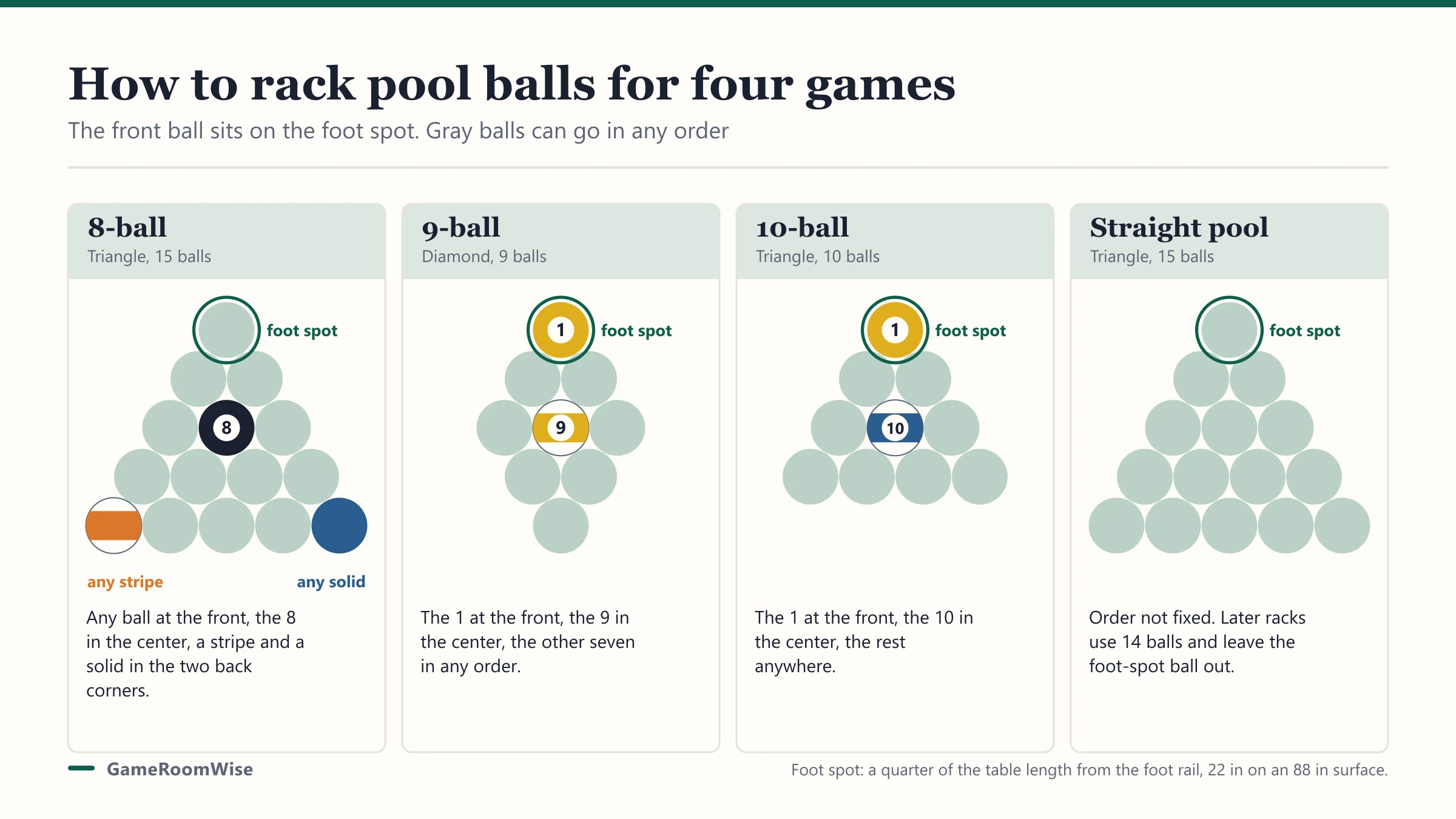
A clean break starts with a clean rack. The layout changes with the game, but the goal is the same every time: the apex ball on the foot spot and every ball touching its neighbors so the break energy carries through the pack. This page gives the correct setup for the four games you will actually play.
How do you rack for 8-ball?
Set the triangle at the foot of the table with the apex ball on the foot spot, the 8-ball in the center, and a stripe in one back corner and a solid in the other. The remaining balls fill in anywhere; only those three positions are fixed.
| Position | Ball |
|---|---|
| Front apex (on the foot spot) | Any ball |
| Center of the rack | 8-ball |
| One back corner | Any stripe (9 to 15) |
| Other back corner | Any solid (1 to 7) |
| All other spots | Any order |
The foot spot is the marked point on the long string, one quarter of the table length from the foot rail, which is the center of the second diamond from that end. Once the balls are in, push them forward from behind so they settle against each other, then lift the triangle straight up. The rules for the game that follows are in our how to play 8-ball pool guide.
How do you rack for 9-ball?
Use the diamond rack for nine balls: the 1-ball at the front apex on the foot spot, the 9-ball in the exact center, and the other seven balls in any order around them. The diamond is four rows of 1, 2, 3, 2, 1 balls.
9-ball is a rotation game, so only the first and center balls are fixed; the break and the order of play do the rest. Because the 9-ball break is struck hard and the breaker aims to pocket the 1 or split the pack, a loose diamond is punished more than a loose 8-ball triangle. A template rack, the thin plastic sheet with ball-shaped cutouts, holds a diamond tighter than a triangle rack can.
How do you rack for 10-ball and straight pool?
10-ball uses a triangle of ten balls with the 1 at the apex on the foot spot and the 10 in the center. The remaining balls go anywhere. It plays like a stricter 9-ball, with called shots, so the tight center placement of the 10 matters.
Straight pool (14.1 continuous) racks all 15 balls in a full triangle with the apex on the foot spot, and the order is not fixed. After the opening break, you re-rack 14 balls each time, leaving the foot-spot ball out so the break ball can scatter the new rack.
| Game | Rack shape | Ball count | Fixed positions |
|---|---|---|---|
| 8-ball | Triangle | 15 | Apex on spot, 8 center, corners split |
| 9-ball | Diamond | 9 | 1 at apex, 9 center |
| 10-ball | Triangle | 10 | 1 at apex, 10 center |
| Straight pool | Triangle | 15 | Apex on the foot spot |
Why won’t my rack sit tight?
A loose rack almost always comes from the cloth and the balls, not the rack itself. Two causes account for most of it:
- A dirty or dented foot spot. Chalk dust and a worn paper spot sticker create a tiny crater that holds balls apart. Clean the area, and if the spot sticker is frayed, replace it.
- Worn or chipped balls. A set with flat spots or size drift will not nest. Our pool balls guide covers when a set is worn past use.
Fresh, well-brushed cloth helps too, because a matted nap lets balls drift. Keep the felt brushed and the surface clean using the steps in our how to clean a pool table guide.
Do you need a template rack?
A template rack is not required, but it produces the tightest, most repeatable rack with the least effort. It is a laser-cut plastic sheet about 0.3 mm thick with cutouts that hold each ball in place; you lay it on the spot, drop the balls in, and leave it under them for the break.
Triangle and diamond racks still work, and most home play uses them. The trick with a wooden or plastic frame is to rack, then reach in and press the balls forward toward the apex with your fingers so the gaps close toward the front, then lift the frame vertically without dragging it. If the back balls still have gaps after lifting, re-rack rather than breaking into a loose pack.
Where exactly is the foot spot?
The foot spot is the point the apex ball sits on, and it is fixed by the table, not by eye. It lies on the long string (the line running lengthwise down the center of the table) at a point one quarter of the playing-surface length from the foot rail, which is the center of the second diamond in from that end.
On an 8 ft table with a 44 in by 88 in playing surface, the foot spot sits 22 in from the foot cushion along the center line. Most tables mark it with a small paper or cloth spot sticker. If yours has lost its sticker, measure it once and mark it, because a rack set a few inches off the spot changes where the break ball travels and can make the apex ball sit over a worn patch. The exact surface dimensions for each table size are in our pool table sizes guide.
Should you rack balls in numerical order?
No. Only the fixed positions for each game matter; everything else is random, and deliberately ordering the other balls gives no legal advantage. In 8-ball the apex, center 8, and the split corners are set, and the rest fill in however they land.
There is one practical habit worth keeping: avoid placing two balls of the same group side by side at the front if you can help it, since a tight front cluster of one group can make the break favor the other player. Beyond that, resist the urge to arrange a “lucky” pattern. Tournament play uses template racks precisely to remove any pattern and any gap, so the break is a test of the stroke, not the setup. For home play, random placement with the fixed balls correct is all the rules ask.
Who needs to be this precise?
Casual players breaking soft for a social game can rack by eye and will not notice a 1 mm gap. The precision matters for anyone breaking hard, playing 9-ball or 10-ball, or keeping score in a league, where a loose rack changes which balls drop and hands an edge no one earned. If your break feels weak and the balls barely spread, the rack is the first thing to fix, before the cue or the stroke.
Where do these layouts come from?
- Rack layouts, fixed positions and foot-spot placement for 8-ball, 9-ball, 10-ball and straight pool: the WPA rules for each game, as summarized in the Wikipedia entries for those games and “Rack (billiards),” read October 2026.
- Template rack construction: common billiards-supply product descriptions, read October 2026.
- Table geometry for the foot spot: our pool table sizes guide.
Frequently asked questions
Quick answers to what readers ask us most
How do you rack pool balls for 8-ball?
Put the triangle with its apex ball on the foot spot, the 8-ball in the exact center of the rack, and one stripe and one solid in the two back corners. Every other ball can go anywhere. Push all the balls forward so they touch before you lift the rack.
Where does the 8-ball go in the rack?
In the center of the triangle, which is the middle ball of the third row. This is the same in both official and bar rules. The apex ball sits on the foot spot, and the two back corners hold one stripe and one solid.
How do you rack 9-ball?
Use a diamond rack of nine balls. The 1-ball goes at the front apex on the foot spot and the 9-ball goes in the center of the diamond. The other seven balls go anywhere. A tight diamond is important because 9-ball breaks hard.
Why does my rack keep breaking up loose?
Usually a dirty or dented foot spot and gaps between worn balls. Clean the cloth, use a template rack or press the balls forward with your hands, and replace a chipped set. A loose rack scatters weakly and leaves clusters.