
How to Play 8-Ball Pool: Rules, Fouls, and Winning
8-ball pool rules in plain English: the rack, the break, open table, calling shots, fouls that give ball in hand, and the ways to win or lose on the 8-ball.
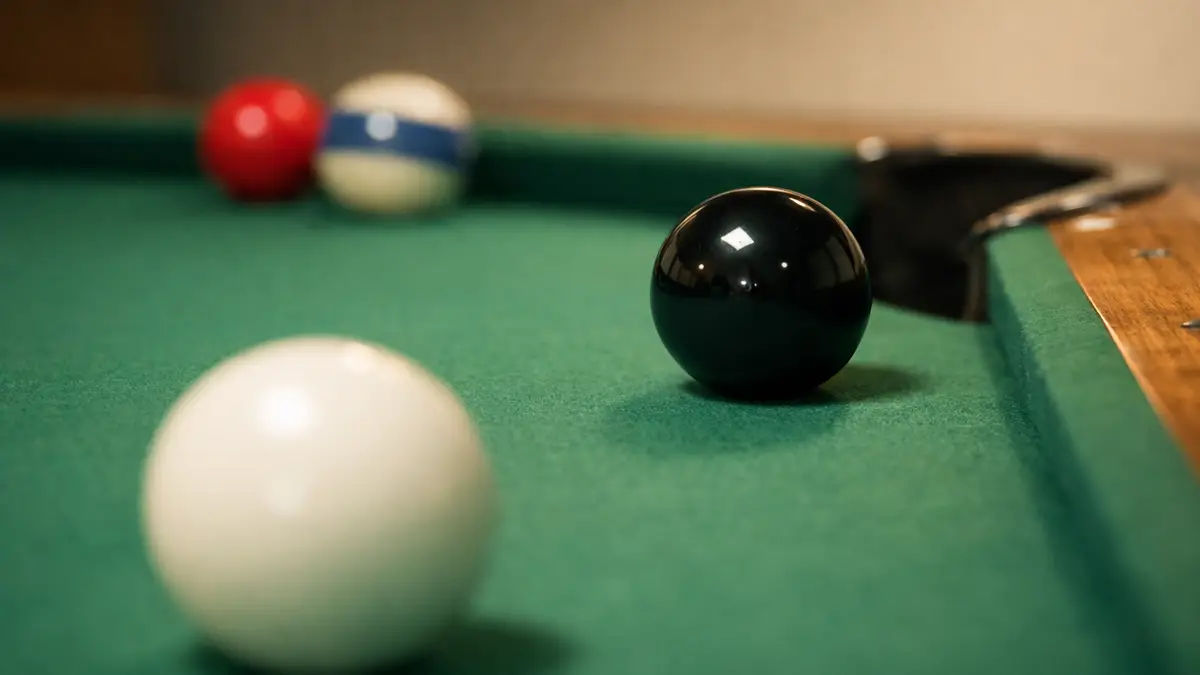
8-ball is the game on most home and bar tables, and most arguments at those tables come from mixing official rules with house rules. This page gives the World Pool-Billiard Association (WPA) rules first, then flags the common bar variations so you know which game you are actually playing.
What is the object of 8-ball?
Pocket your whole group of seven balls, then pocket the 8-ball in a called pocket. One player shoots the solids, numbered 1 to 7; the other shoots the stripes, numbered 9 to 15. The 8-ball belongs to neither group until the end.
The groups are not fixed at the start. The table is “open” after the break, and a player claims a group only by legally pocketing a called ball from it once the table is open. You cannot win by potting the 8-ball early: it must be the last ball you sink, after every ball in your group is gone.
How do you set up and break?
Rack all 15 balls in a triangle with the 8-ball in the center, the apex ball on the foot spot, and a stripe in one back corner and a solid in the other. The full layout is in our how to rack pool balls guide.
The breaker places the cue ball anywhere behind the head string (the line through the second diamond from the head rail) and strikes the rack. For a legal break, the breaker must either pocket a ball or drive at least four object balls to a rail. If the break is not legal, the incoming player can accept the table or re-rack and break.
| Break outcome (WPA) | Result |
|---|---|
| A ball pocketed, no scratch | Table stays open, breaker continues |
| Four balls hit rails, none pocketed | Table open, turn passes |
| Cue ball scratched | Foul, opponent gets ball in hand behind the head string |
| 8-ball pocketed on break | Re-spot and play on, or re-rack, breaker’s choice |
| Fewer than four balls to rails, none potted | Illegal break, opponent’s choice |
How are solids and stripes assigned?
Groups are assigned the first time a player legally pockets a called ball after the break, while the table is open. If you call the 3 in the corner and it drops on a legal hit, you are solids for the rest of the game and your opponent is stripes.
While the table is open, you may hit a solid first to pocket a stripe or the reverse; nothing is yours yet. Once groups are set, you must always strike one of your own balls first. The 8-ball is never a legal first ball to contact until your group is cleared.
What counts as a foul in 8-ball?
A foul gives your opponent the cue ball in hand, which they may place anywhere on the table. The common fouls under WPA rules:
- Pocketing the cue ball (a scratch) or driving it off the table.
- Failing to hit one of your own group first once groups are set.
- No ball reaching a rail after the cue ball contacts an object ball.
- Not having at least one foot on the floor when you shoot.
- Touching any ball with anything but the cue tip on a legal stroke.
- A double hit or a push shot.
Ball in hand is the sharpest penalty in the game, which is why league players treat a safety (a defensive shot that leaves the opponent no shot) as a real option instead of forcing a low-percentage pot. A good playing cue and a clean set of pool balls make the difference between a controlled safety and an accidental foul.
How do you win, and how do you lose, on the 8-ball?
You win by pocketing the 8-ball in your called pocket after clearing your group, with no foul on the shot. You must call the pocket; the 8 dropping in a pocket you did not name is a loss under official rules.
You lose immediately if you:
- Pocket the 8-ball before clearing your group.
- Pocket the 8-ball in the wrong pocket.
- Knock the 8-ball off the table.
- Scratch the cue ball on the shot that pockets the 8-ball.
That last one surprises casual players: potting the 8 and scratching on the same stroke is a loss, not a win.
Which rules change in bar and house play?
House rules trade precision for speed, and the differences are worth settling before the break. The table below lines up the official rule against the versions you will meet on a bar table.
| Situation | WPA official | Common bar house rule |
|---|---|---|
| 8-ball on the break | Re-spot or re-rack | Instant win |
| Scratch on the break | Ball in hand behind head string | Ball in hand anywhere, or loss of turn |
| Calling shots | Ball and pocket called | Slop: any legal pot counts |
| Scratch while on the 8 | Loss | Loss, or 8 re-spots, varies |
| Last-pocket rule | Not used | 8 must go in the pocket where your last group ball fell |
None of these are wrong, but a game is only fair if both players agree on the set before the first shot. For a new group, a two-minute read of this page settles most of it. To plan the room the table sits in, including cue clearance at every rail, use the game room planner and check the bed size in our pool table sizes guide.
How does ball in hand work?
Ball in hand means the incoming player picks up the cue ball and places it anywhere on the table before shooting. It is the standard penalty for a foul under WPA rules, and it is far harsher than the old “two shots” or “loss of turn” penalties some house games still use.
The practical effect is that fouls decide games at every level above casual. A player who leaves the cue ball free for the opponent has handed them a perfect position on any ball. This is why experienced players will take an intentional safety rather than risk a foul: giving up a turn is cheaper than giving up ball in hand. Place the cue ball with a thought for the next shot after it, not just the one in front of you.
What is a safety, and when should you play one?
A safety is a defensive shot: you legally hit your own ball first and leave the cue ball where your opponent has no makeable shot, instead of trying to pocket a ball. It is legal as long as the stroke meets the foul rules, meaning your ball is struck first and a ball reaches a rail.
Play a safety when the table is bad for you: your balls are tied up in a cluster, the only pot is low-percentage, or a cluster of your opponent’s balls blocks every pocket. Rolling the cue ball behind one of your own balls, so the opponent cannot hit their group cleanly, forces them to either foul or leave you an opening. Safeties are not stalling; under official rules they are a core part of the game, and matches between strong players often turn on who defends better, not who pots harder. A controlled cue tip, covered in our best pool cues guide, makes a precise safety far easier than a worn tip does.
Who these rules are not for
Players in a sanctioned league should use their league’s own rulebook, not this summary. BCA Pool League, APA and UK eight-ball each tweak the WPA rules on fouls, the break and the 8-ball, and a league referee follows that book. This page is for home and casual play, where the goal is a fair, fast game everyone at the table understands.
Where do these rules come from?
- Object, groups, open table, break, fouls and 8-ball outcomes: the WPA World Standardized Rules for 8-ball, as summarized in the Wikipedia “Eight-ball” and “Rules of eight-ball” entries, read October 2026.
- House and bar variations: common North American tavern rules noted in the same sources and in league rulebooks.
- Rack layout and table setup: our how to rack pool balls guide.
Frequently asked questions
Quick answers to what readers ask us most
What are the basic rules of 8-ball pool?
One player takes solids (1 to 7), the other stripes (9 to 15). You must pocket all of your group, then pocket the 8-ball in a called pocket to win. Hitting the wrong ball first, pocketing nothing, or scratching the cue ball is a foul that gives your opponent ball in hand.
What happens if you pot the 8-ball on the break?
Under WPA rules it is not a loss. The breaker may re-spot the 8-ball and play on, or re-rack and break again. In many bar house rules it is an instant win, which is one of the biggest differences between league and casual play.
Do you have to call your shots in 8-ball?
In official rules, yes: you name the ball and the pocket, and obvious shots do not need the detail called. Many casual games play slop, where any ball pocketed on a legal hit counts. Agree on this before you break.
What happens if you scratch on the 8-ball?
Under WPA rules, scratching (pocketing the cue ball) while legally pocketing the 8-ball is a loss. So is pocketing the 8-ball in the wrong pocket or knocking it off the table. The game ends on an illegally pocketed 8-ball.