
Shuffleboard Rules: How to Play and Score
Table shuffleboard rules: how to play, how the 1-2-3 zones and the hanger score, the one-color-scores-per-frame rule, foul lines, and games to 15 or 21 points.
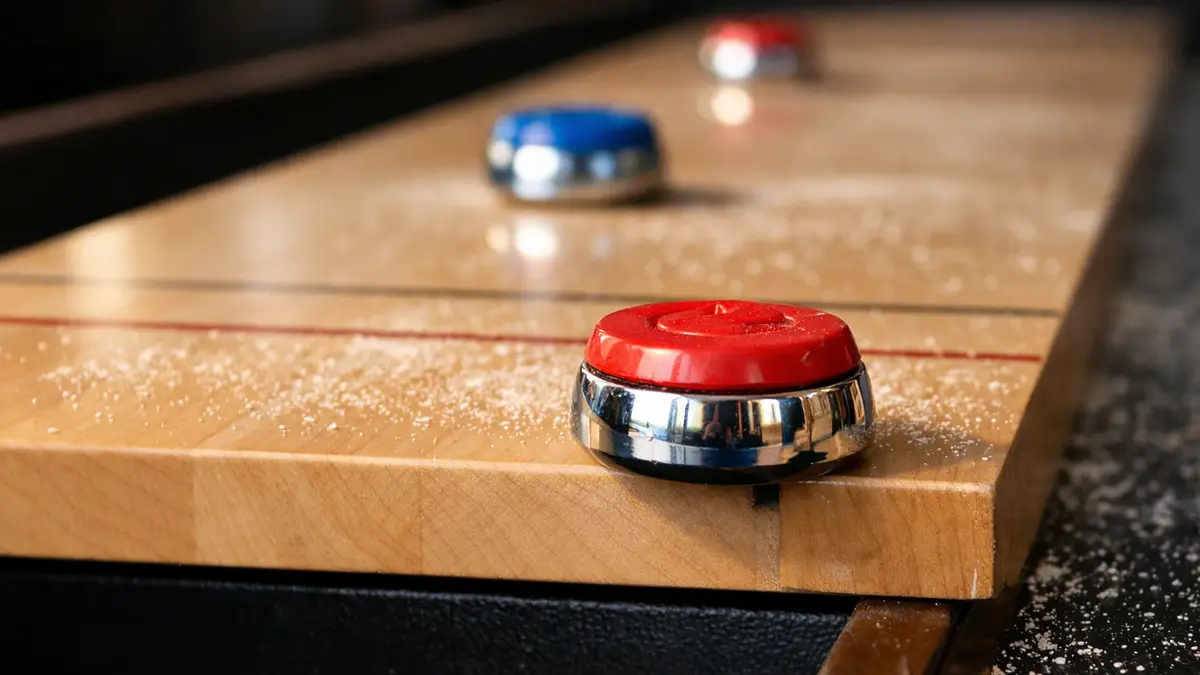
Table shuffleboard looks simple and scores in a way that surprises almost everyone the first time: only one player scores each frame, no matter how many weights land in the zones. This page explains the play, the scoring and the fouls so your first game does not stall on an argument.
How do you play table shuffleboard?
Two players or two teams stand at the same end and take turns sliding weights down the table toward the scoring zones at the far end. There are 8 weights, 4 per color, and players alternate shots: one color, then the other, until all 8 are played. That set of 8 shots is a frame (sometimes called a round).
The goal of a shot is to leave your weight farther down the table than your opponent’s best weight, ideally in a high zone, while knocking theirs out of scoring or into the gutter. After all 8 weights are thrown, you score the frame, clear the table, and play the next frame. Shuffleboard powder on the playfield is what lets the weights glide; our shuffleboard powder guide covers which speed to use.
How does scoring work?
The far end of the table is marked with scoring zones worth 1, 2 and 3 points, rising toward the end. A weight scores the value of the zone it stops in. A weight that slides all the way to the edge and hangs over without falling is a hanger, worth 4 points.
The rule that trips up new players: only one color scores per frame. You count only the weights of whichever color has the single weight farthest down the table, and you count only that color’s weights that are farther than the opponent’s farthest scoring weight.
| Result | Points |
|---|---|
| Weight in the 1 zone | 1 |
| Weight in the 2 zone | 2 |
| Weight in the 3 zone | 3 |
| Hanger (over the end edge) | 4 |
| Weight short of the deadline, or in the gutter | 0 |
Can you walk through a scoring example?
Say red has a weight in the 3 zone and another in the 2 zone. Blue’s best weight is in the 1 zone, closer to the players than both red weights. Red scores, blue scores nothing. Red counts only the weights past blue’s best, so red gets 3 plus 2, for 5 points that frame.
Now imagine blue’s best weight sits in the 2 zone, farther down than red’s weight in the 1 zone but closer than red’s weight in the 3 zone. Only one color can score: blue’s farthest weight (the 2) is not past red’s 3, so red leads, and red scores only the single weight that is farther than blue’s best, the 3, for 3 points. Everything closer to the players than the opponent’s best weight is dead for scoring that frame.
What are the fouls and the foul line?
A weight must come to rest completely past the nearest scoring line, usually called the deadline or foul line, to count. A weight short of that line scores nothing and is removed before the next shot so it does not interfere.
Other weights that score nothing:
- A weight that slides off the end of the table onto the floor.
- A weight that drops into the side gutter.
- A weight the shooter touches after releasing, or that is knocked by a player.
Knocking an opponent’s weight off the board or into the gutter is legal and is a core tactic, not a foul. So is using your weight to push your own weight farther down the table.
How many points wins, and when do you switch ends?
Games are played to 15 or 21 points, agreed before the first shot. After each frame you total the scoring color’s points, add them to the running score, and play the next frame. The player or team that was scored on usually shoots first in the next frame.
In a full game you switch ends after each frame or at an agreed point, so neither side gets an advantage from a faster or slower side of the table. Longer tables reward touch and let a well-placed weight sit safely at the far 3; our shuffleboard table buying guide covers lengths from 9 to 22 ft, and the game room size guide gives the room each length needs.
What are the basic strategies and shot types?
Three shots cover most of table shuffleboard. The lag is a soft shot aimed to stop a weight high in the 3 zone or hang it over the edge. The knock-off drives an opponent’s scoring weight off the board or into the gutter. The block or guard sets a weight short of the zones to make the opponent’s knock-off harder.
The deeper tactic is shooting order: the player who shoots last in a frame (the hammer) has a big advantage, because they see all other weights before their final shot and can either score or knock off to win the frame. Good players use early weights to set up position and save a knock-off for last. Speed control comes from the powder on the board, so matching powder to the table and the room’s humidity is part of the game, not just maintenance; our shuffleboard powder guide covers which grade to spread.
How long is a game, and how do teams play?
Most house games run to 15 points, with 21 a longer alternative; tournament play often uses 15. You play frame after frame, scoring the leading color each time, until one side reaches the target, and you must usually win outright rather than by 2 unless a house rule says otherwise.
Table shuffleboard is played one-on-one or two-on-two. In doubles, partners split to opposite ends: one partner from each team shoots from one end for a frame, then the other partners shoot from the other end for the next frame, so everyone plays. Singles players shoot all four of their own weights each frame from the same end and then walk to the other end to shoot back. Either way, the alternating-shot and one-color-scores rules stay the same.
Which shuffleboard is this, and who are these rules not for?
These rules are for table shuffleboard, the raised wooden table with weights and powder. They are not deck shuffleboard or floor shuffleboard, the outdoor and cruise-ship game played on the ground with cues and discs into a triangle, which scores differently and is a separate game despite the shared name.
If you are playing on a multi-game table that includes shuffleboard, check the maker’s own zone markings, since smaller playfields sometimes relabel the zones; our multi-game tables guide covers those. For a sanctioned table shuffleboard league, follow the specific association’s rulebook, which fixes the game length, the shot order and how disputed hangers are measured.
Where do these rules come from?
- Play, the 1-2-3 zones, the hanger, the one-color-scores rule and foul lines: common table shuffleboard rules as summarized in the Wikipedia “Table shuffleboard” entry, read October 2026.
- Game length conventions (15 and 21 points): the same source and typical house rules.
- Table lengths and powder: our shuffleboard table buying guide and shuffleboard powder guide.
Frequently asked questions
Quick answers to what readers ask us most
How do you score in table shuffleboard?
Each weight scores by the zone it stops in at the far end: 1, 2 or 3 points, or 4 if it hangs over the end edge without falling. But only one player scores per frame, and only for weights sitting farther down the table than the opponent's farthest scoring weight.
How many points do you need to win shuffleboard?
Games are commonly played to 15 or 21 points, agreed before you start. Players alternate shooting all 8 weights each frame, score the frame, then play again from the same end or switch ends until one player reaches the target.
What is a hanger in shuffleboard?
A hanger is a weight that slides to the very end and hangs over the edge of the playfield without falling off. It scores 4 points, the highest single-weight score, and beats any weight sitting fully on the board.
Does a weight have to cross a line to count?
Yes. A weight must come to rest completely past the nearest scoring line, often called the foul or deadline, or it scores nothing and is removed. A weight that falls into the gutter or off the end also scores nothing.